 Hot
Hot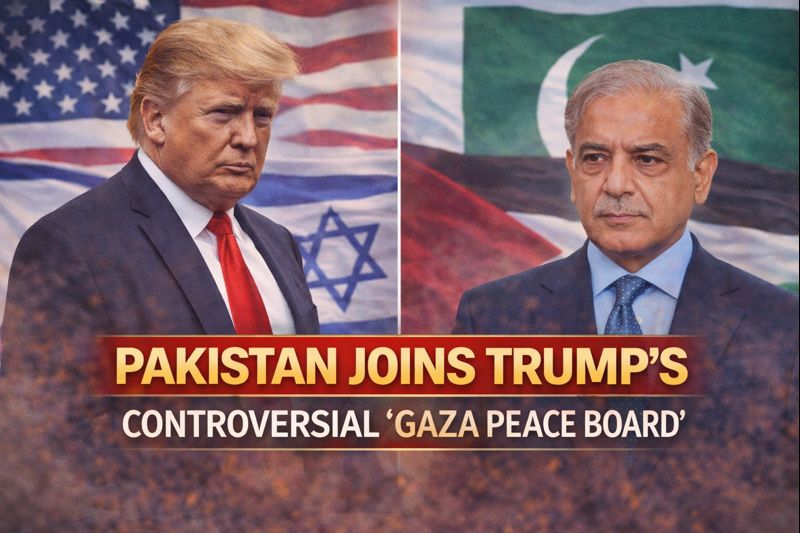
Pakistan Joins Trump’s Controversial “Gaza Peace Board”
In a move that’s sparking intense global controversy, Pakistan has officially accepted US President Donald Trump’s invitation to join the “Board of Peace” (BoP) focused on Gaza. Announced on January 21, 2026, by Pakistan’s Foreign Ministry, this decision positions the country alongside seven other Muslim-majority nations—Egypt, Jordan, UAE, Indonesia, Turkey, Saudi Arabia, and Qatar—in a joint effort to support a permanent ceasefire, humanitarian aid, reconstruction, and lasting peace in Gaza.
The Board of Peace stems from Trump’s 20-point Gaza Peace Plan, endorsed by UN Security Council Resolution 2803 in late 2025. Described as an international transitional body, it aims to oversee Gaza’s postwar management until the Palestinian Authority can securely take control. Trump pitched it as a “new framework” for conflict resolution, potentially expanding beyond Gaza to other global hotspots, which has fueled much of the backlash.
Pakistan’s Prime Minister Muhammad Shehbaz Sharif will represent the nation at the board’s inaugural meeting, expected during Trump’s signing ceremony in Davos on January 22. The Foreign Ministry stated this aligns with Pakistan’s “ongoing efforts to support the implementation of the Gaza Peace Plan,” emphasizing hopes for “concrete steps towards permanent ceasefire, scaling up humanitarian aid, and reconstruction of Gaza.” Officials highlighted Pakistan’s pro-Palestine stance, viewing the board as a platform to advocate for Palestinian self-determination and statehood under international law.
PR No.22/2026 Pakistan Accepts Invitation for Joining the Board of Peace (BoP) with the View to Achieving Lasting Peace in Gaza. In response to the invitation extended to Prime Minister Muhammad Shehbaz Sharif by the President of the United States, H.E. Donald J. Trump, Pakistan would like to announce its decision to join the Board of Peace (BoP) as part of its ongoing efforts to support the implementation of the Gaza Peace Plan under the framework of the United Nations Security Council Resolution 2803. https://mofa.gov.pk/press-releases/pakistan-accepts-invitation-for-joining-the-board-of-peace-bop-with-the-view-to-achieving-lasting-peace-in-gaza
— Ministry of Foreign Affairs - Pakistan (@ForeignOfficePk) January 21, 2026
Why the Controversy?
The announcement has triggered heated debates across political spectrums. Critics argue it legitimizes Trump’s US-centric approach, which some see as bypassing Palestinian authority and favoring Israel. Israel’s early acceptance of the board—along with countries like UAE and Morocco (from prior Abraham Accords)—raises fears of normalizing occupation without addressing root causes like settlements or right of return.
In Pakistan, where public sentiment strongly supports Palestine, opposition voices are loud. Historian and activist Ammar Ali Jan called it a “bigger blunder than SEATO/CENTO and Afghan Jihad,” warning it could aid a “colonial occupation” and stabilize a “declining empire.” Social media erupts with concerns that joining a board with Israel dilutes Pakistan’s historic solidarity with Palestinians, especially amid Gaza’s devastation from Israel’s war since October 2023, which has killed over 40,000 and displaced millions.
Proponents, however, see strategic gains: bolstering Pakistan’s global influence in the Middle East, strengthening ties with Trump (amid US-Pakistan relations thaw), and contributing to peace efforts. Analysts like Michael Kugelman note it’s unsurprising—Pakistan seeks to enhance its diplomatic footprint while public rejection won’t deter power holders.
Globally, the board divides. Over two dozen countries have joined, including Kosovo, Hungary, Belarus, Azerbaijan, Armenia, and others, but major European allies snub it. France, Germany, and the UK hesitate, viewing it as coercive—tied to Trump’s tariff threats on non-cooperators. Russia’s Putin is “considering” amid Mideast settlement talks. Critics label it “Trump’s vanity project,” potentially fracturing alliances like NATO while ignoring UN mechanisms.
(Responsive / Native Ad)
The board’s mandate includes funding Gaza redevelopment (estimated $30-50 billion), security oversight, and broader conflict resolution. Trump envisions a “panel of world leaders” for “searching for possible ways to resolve pressing problems,” but skeptics fear it expands US hegemony, especially with Trump’s refusal to rule out force in other disputes like Greenland.
Impact on Diplomacy and the Region
For Gaza, the board promises reconstruction aid and ceasefire consolidation, but without Hamas or direct Palestinian input, its legitimacy is questioned. Palestinian officials have mixed reactions—some welcome aid, others decry exclusion.
Pakistan’s involvement marks a diplomatic pivot: historically vocal against Israel (no formal ties), it now shares a table, potentially opening doors for normalization talks. This could strain relations with Iran or domestic Islamists but boost economic ties with Gulf states also on board.
The controversy underscores 2026’s geopolitical shifts: Trump’s “America First” reshaping alliances, BRICS countering with CBDCs, and Middle East realignments post-Gaza war. As Davos unfolds, eyes are on whether more join or boycott—Pakistan’s yes amplifies the divide.
This “high controversy potential” decision will fuel debates: Is it a bold peace step or a risky sellout? As one Pakistani commentator put it, “The people stand with Palestine—will the regime?”
Joining Trump's "board of peace" will be a bigger blunder than SEATO/CENTO and Afghan Jihad. The plan aims to continue the genocide in Gaza & stabilise a declining empire. People of Pakistan stand with Palestine and will not tolerate if the regime joins this colonial occupation.
— Ammar Ali Jan (@ammaralijan) January 18, 2026