 Hot
Hot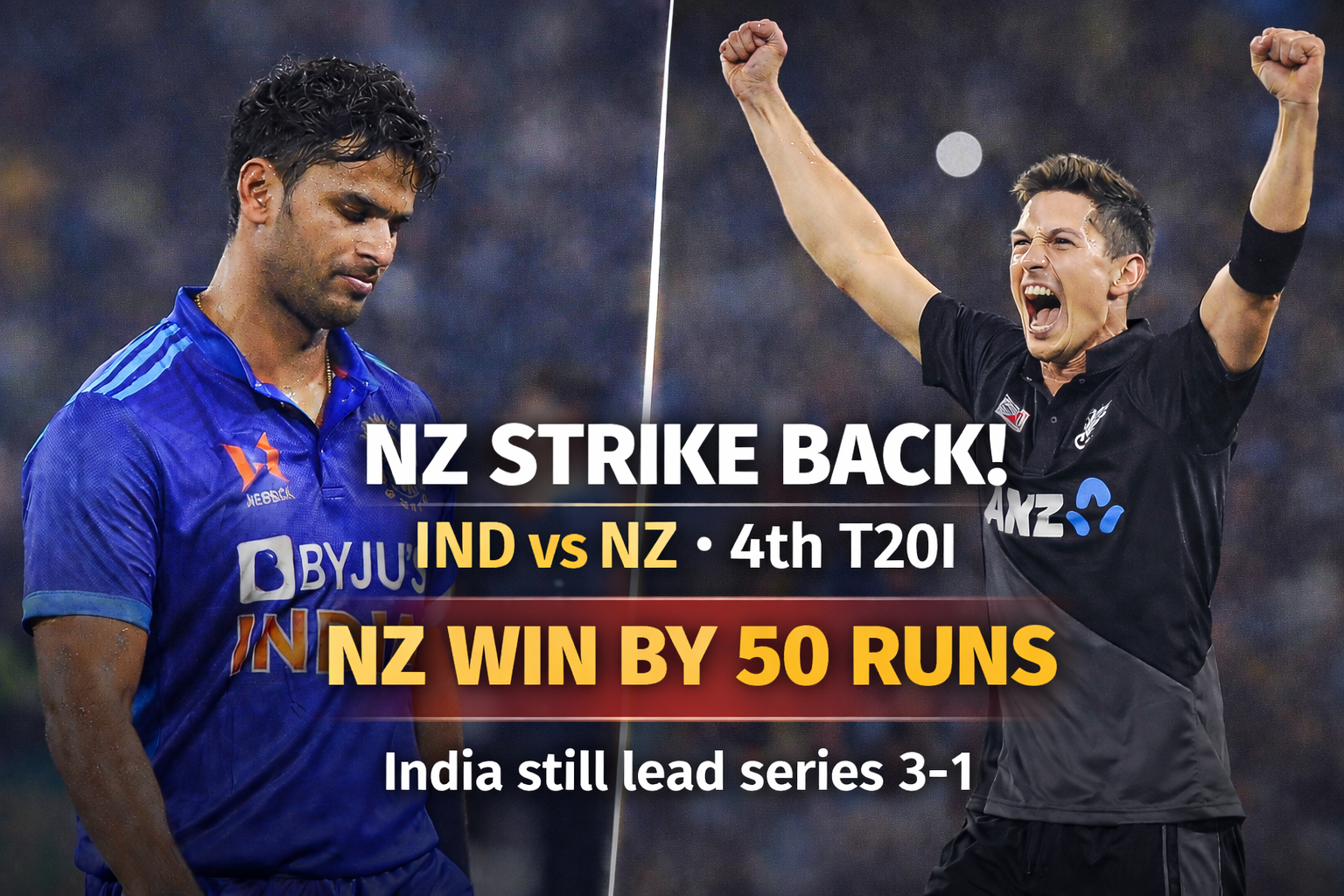
New Zealand finally broke through in the five-match T20I series against India, securing a convincing 50-run victory in the 4th T20I at Visakhapatnam on January 28, 2026. With the series already clinched by India at 3-1, the Black Caps showed resilience and skill to avoid a whitewash.
India opted to bowl first after winning the toss, but New Zealand posted a formidable 215/7 in their 20 overs. Tim Seifert led the charge with a quickfire 62 off 36 balls, supported by Devon Conway’s 44 off 23. The Kiwi middle order accelerated effectively, with contributions from lower-order hitters keeping the momentum.
India’s bowlers, including Arshdeep Singh (2/33), picked up wickets but couldn’t contain the scoring rate on a good batting surface at the ACA-VDCA Stadium.
India’s Batting Collapse Despite Dube Heroics
Chasing 216, India’s innings unraveled quickly. Openers Abhishek Sharma and others fell cheaply, leading to a top-order collapse that left the hosts struggling early. Suryakumar Yadav and other key batters couldn’t build partnerships, putting immense pressure on the middle order.
Enter Shivam Dube—the lone warrior. The left-hander unleashed a stunning assault, racing to 65 off just 23 balls, including seven massive sixes. His 15-ball fifty was one of the fastest by an Indian in T20Is, featuring brutal hitting against spinners like Ish Sodhi. Dube briefly revived hopes, lifting India from a precarious position to within striking distance.
However, once Dube fell—dismissed in an unlucky manner—the resistance crumbled. Mitchell Santner was the chief destroyer with 3/26, exploiting the spin-friendly conditions and picking up crucial wickets. Rinku Singh contributed 39 off 30, but no one else could match Dube’s firepower.
India were bundled out for 165 in 18.4 overs, handing New Zealand their first win of the series.

Key Performers and Turning Points
For New Zealand, Tim Seifert earned Player of the Match for his anchoring knock and aggressive intent. Mitchell Santner’s all-round impact—economical bowling and handy batting—proved decisive in restricting India.
(Responsive / Native Ad)
India’s batting frailties were exposed against quality spin and variations. The top order’s inability to convert starts and middle-order collapses continue to be a concern, even in a dominant series win.
The victory gives New Zealand momentum heading into the final T20I on January 31, where they aim to narrow the gap further and end the tour on a high.
Series Context and What’s Next
India had dominated the first three matches, showcasing depth in batting and bowling. This loss, while not affecting the series outcome, serves as a reality check before bigger challenges like the upcoming T20 World Cup preparations.
Fans in Visakhapatnam witnessed high drama—Dube’s fireworks lit up the stadium, but New Zealand’s disciplined effort stole the show.
NZ WIN BUT DUBE SHINES! 💔 New Zealand beat India by 50 runs in the 4th T20! NZ: 215/7 (Seifert 62) IND: 165 All Out (Dube 65) 🔥 Shivam Dube (65 off 23) played a lone warrior knock with 7 sixes! 🚀 India still leads the series 3-1. 🇮🇳 #INDvNZ #ShivamDube #TeamIndia #CricketTwitter #VizagT20
— Amit Kumar (@amitkr132005) January 28, 2026
Shivam Dube hammered the third-fastest fifty by an India batter in T20Is, finishing with 65 off 23 balls, but it wasn't enough as the New Zealand bowlers continued to chip away to register a 50-run win in the fourth T20I in Visakhapatnam #indvsnz4tht20
— SportoGraphy (@ajangid346) January 28, 2026
As the series concludes in the final match, both teams will look to fine-tune combinations. For India, addressing batting consistency will be key; for New Zealand, this morale-boosting win could spark better performances ahead.