 Hot
Hot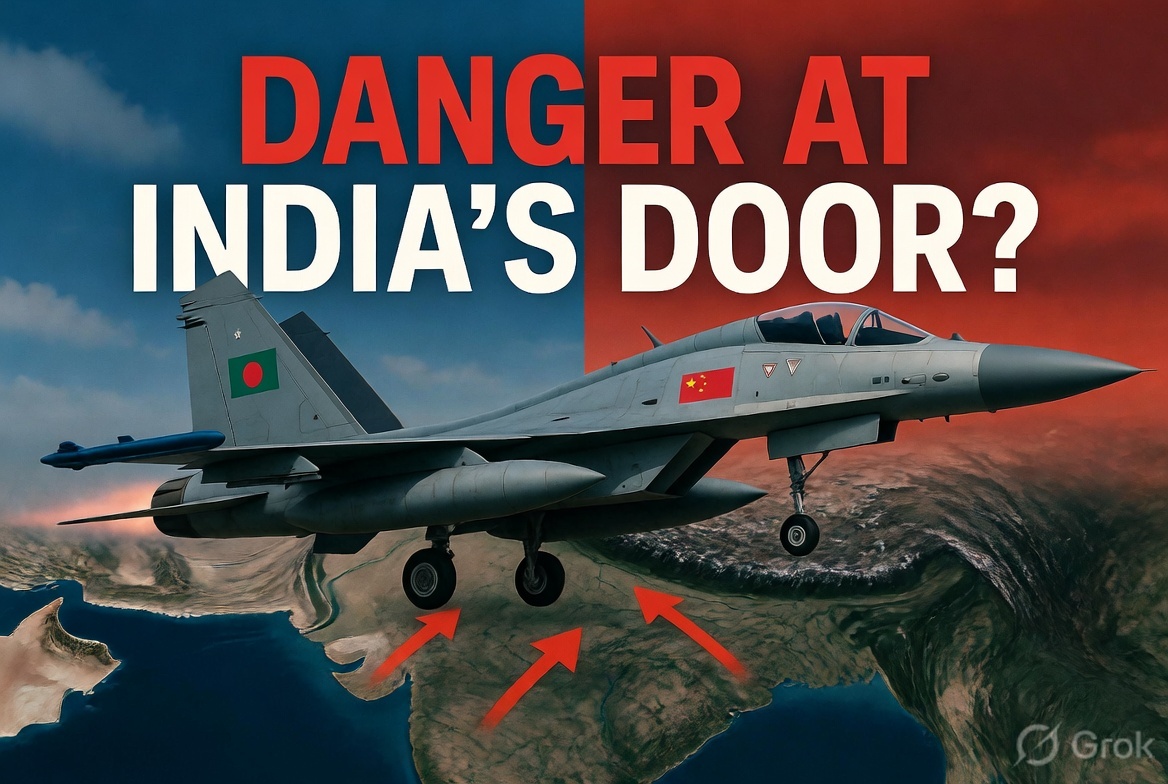
A potential arms deal between Bangladesh and China is raising serious alarm bells in New Delhi — and for good reason.
Reports confirmed this week that Bangladesh is in advanced negotiations to acquire 24 Chinese-made J-10CE “Vigorous Dragon” fighter jets in a deal worth approximately $2.2 billion. The purchase is expected to be a headline item during Prime Minister Tarique Rahman’s upcoming visit to Beijing, with a target signing date of August 2026.
What makes this particularly sensitive for India? The J-10CE is the same Chinese export aircraft that Pakistan reportedly used against the Indian Air Force during Operation Sindoor in May 2025.
What Is the J-10CE “Vigorous Dragon”?
The J-10CE (Chengdu J-10 “Vigorous Dragon”) is China’s most advanced export-ready multirole fighter:
| Specification | Detail |
|---|---|
| Classification | 4.5-generation multirole fighter |
| Engine | WS-10B turbofan (Chinese-made) |
| Key Feature | AESA (Active Electronically Scanned Array) Radar |
| Air-to-air missiles | PL-15 beyond-visual-range missiles |
| Current foreign operator | Pakistan (the only current foreign user) |
| Bangladesh order | 24 aircraft, ~$2.2 billion |
If Bangladesh signs the deal, it would become only the second nation after Pakistan to operate the J-10CE — a fighter jet explicitly designed to rival Western platforms like the F-16 and French Rafale.
Why Bangladesh Wants These Jets
Bangladesh’s military modernisation has been ongoing for years under its “Forces Goal 2030” programme. The J-10CE acquisition is designed to:
- Replace Bangladesh’s ageing fleet of F-7 fighters and MiG-29s, which are increasingly obsolete
- Provide the Bangladesh Air Force (BAF) with a genuine supersonic, beyond-visual-range (BVR) combat capability
- Position Bangladesh as a more credible regional military power
From Bangladesh’s perspective, this is a straightforward military upgrade. From India’s perspective, it’s anything but.
The Operation Sindoor Connection — Why India Is Alarmed
In May 2025, India launched Operation Sindoor — a series of precision airstrikes against terrorist infrastructure in Pakistan and Pakistan-administered Kashmir — following the Pahalgam terror attack. During the brief aerial conflict that followed:
- Pakistan reportedly deployed its J-10CE fleet against the Indian Air Force
- Indian jets — including Rafales, Su-30MKIs, and Mirage 2000s — were involved in engagements
- The J-10CE’s PL-15 long-range missile and AESA radar were specifically highlighted as capabilities that challenged Indian air defences
Now, with Bangladesh potentially acquiring the same platform, Indian strategists are running new threat assessments for the country’s critical eastern theatre.
The Siliguri Corridor: India’s Strategic Achilles Heel
The single most alarming geographic consideration for Indian security planners is the Siliguri Corridor — commonly called the “Chicken’s Neck”:
(Responsive / Native Ad)
- A narrow strip of land, just 20-22 km wide, connecting Northeast India (seven states) to the rest of the country
- If threatened or severed — even briefly — it would effectively cut off 50 million people and critical Indian military positions
- Bangladesh’s acquisition of long-range J-10CE jets capable of striking deep into Indian territory from Bangladeshi airbases near this corridor is a scenario that Indian planners cannot ignore
Security analyst assessment:
“A J-10CE squadron based in western Bangladesh, armed with PL-15 missiles, would place India’s Siliguri Corridor within theoretical strike range. This isn’t an existential threat today — but it changes India’s eastern theatre planning calculus significantly.”
How India Is Responding
New Delhi has not issued any formal protest, but Indian officials are reportedly monitoring the situation “very closely.” Key Indian responses in the background:
- Intelligence and surveillance of the Bangladesh-China talks have been elevated
- Diplomatic back-channels with Dhaka are reportedly active to gauge the depth of the Bangladesh-China defence alignment
- Indian Air Force eastern command is reviewing its own modernisation timeline for the region
India’s overall air power advantage remains significant — the IAF fields Rafales, Su-30MKIs, Tejas Mk1A, and is acquiring more advanced platforms. But the trend of Chinese military hardware encircling India — from Pakistan in the west to Bangladesh potentially in the east — is what alarms strategists.
The Bigger Geopolitical Picture
This potential deal is part of a broader pattern of China’s expanding military footprint in the Bay of Bengal region:
- China has already built strategic port infrastructure in Sri Lanka (Hambantota) and Bangladesh (Chittagong)
- Bangladesh is increasingly dependent on Chinese economic investment for its infrastructure
- The Tarique Rahman government in Dhaka has been tilting strategically toward Beijing since coming to power
For India, which shares its longest land border with Bangladesh (4,156 km), the deepening of Bangladesh-China military ties is a significant strategic development — regardless of whether the jet deal ultimately goes through.
The J-10CE deal isn’t signed yet. But the conversation it has sparked is already reshaping how India, China, and Bangladesh view South Asian security in the post-Operation Sindoor era.
Stay updated on South Asian defence developments with TrendPulse.