 Hot
Hot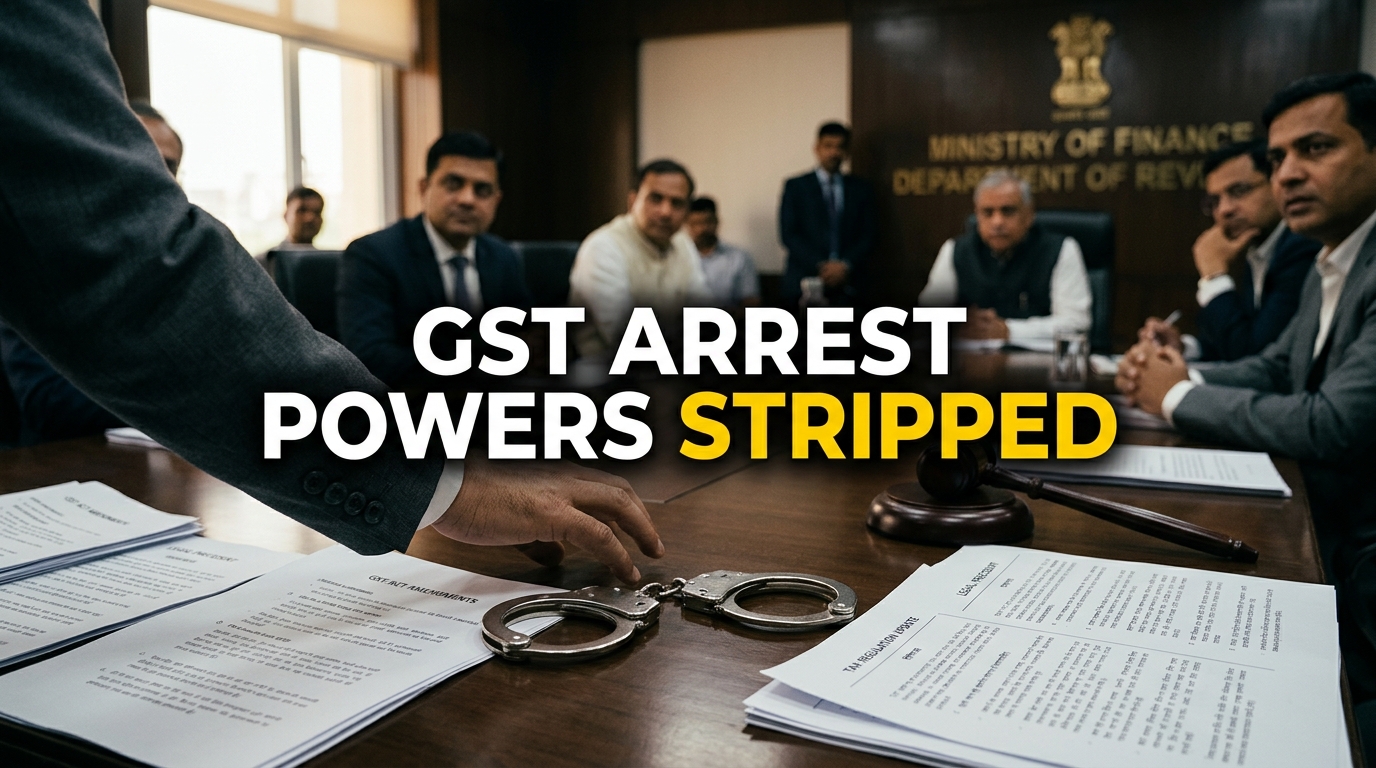
In what corporate chambers and small business federations are hailing as the most significant structural de-escalation of bureaucratic coercion since the inception of India’s indirect tax overhaul, the 57th Goods and Services Tax (GST) Council on October 8, 2026, officially recommended scrapping the discretionary arrest powers of tax enforcement officers.
Presided over by Union Finance Minister Nirmala Sitharaman and state finance ministers in New Delhi, the Council approved a sweeping package of procedural and decriminalization reforms set to take effect on April 1, 2027. Chief among the amendments is the outright elimination of field officers’ authority to execute unilateral arrests under the CGST Act, coupled with a fivefold increase in the threshold for launching criminal prosecution—surging from the previous ₹1 crore mark up to ₹5 crore.
| Landmark GST Council Reforms | Old Policy Regime vs. New Mandate (Effective April 2027) |
|---|---|
| Tax Officers’ Arrest Powers | Unilateral administrative detention permitted ➔ Arrest powers scrapped; judicial prosecution only |
| Criminal Prosecution Threshold | ₹1 Crore tax evasion limit ➔ Raised 5x to ₹5 Crore |
| Sentencing Discretion | Mandatory minimum imprisonment terms ➔ Discretion transferred entirely to judicial courts |
| Minor Dispute Nuisance Threshold | Notices issued for trivial amounts ➔ No notices for under ₹10,000; all existing sub-₹10K notices dropped |
| General Penalty Cap | ₹25,000 baseline penalty ➔ Slashed to ₹10,000 |
| Enforcement Philosophy | Coercive pre-trial detention leverage ➔ Trust-based digital reconciliation and civil recovery |
Dismantling the Coercive Arsenal: Why the Midnight Summons Culture Had to Fall
For years, Section 69 and Section 132 of the Central GST Act were criticized by corporate attorneys and industry associations as statutory tools of “tax terrorism.” Under the outgoing legal framework, tax inspectors wielding suspicions of input tax credit (ITC) mismatches or classification discrepancies possessed the unilateral power to detain company executives, directors, and proprietary traders before any formal charge sheet or judicial adjudication had concluded.
This administrative power gave rise to an aggressive culture of midnight summons, coercive spot-recovery payments extracted under duress, and pre-trial reputational destruction for legitimate business owners caught in procedural billing disputes.
Under the new directives announced by Finance Minister Sitharaman, criminal proceedings will strictly require judicial process. While fraudulent syndicates operating systematic counterfeit invoice rackets can still be prosecuted through the formal court system, executive officers on the ground will no longer hold the unchecked leverage of arbitrary imprisonment.
Breathing Room for MSMEs: Shielding Entrepreneurs from Weaponized Audits
The dramatic hike in the prosecution threshold from ₹1 crore to ₹5 crore provides vital breathing room for India’s micro, small, and medium enterprises (MSMEs). In modern high-volume, low-margin supply chains, cumulative tax disputes involving disputed invoices could easily breach the previous ₹1 crore barrier, exposing small factory owners and regional distributors to criminal jeopardy over vendor non-compliance.
Furthermore, the Council enacted an immediate relief mechanism for micro-traders: tax authorities are now strictly prohibited from issuing demand notices for amounts below ₹10,000, with all pending retrospective notices beneath this monetary threshold ordered dismissed immediately.
“For nearly a decade, the threat of an inspector arriving with handcuffs was the sword of Damocles hanging over every growing enterprise,” remarked tax jurist and corporate advisor Arvind Singhania. “By stripping executive arrest powers and raising the bar to ₹5 crore, the government has decisively untangled routine civil accounting errors from deliberate criminal fraud. It restores the principle that business owners are taxpayers, not presumptive criminals.”
Mid-Article Ad Space
(Responsive / Native Ad)
The Enforcement Backlash: How Will Revenue Teams Catch Fake Invoice Syndicates?
While industry associations celebrated, the Council’s landmark decision has stirred quiet unease within enforcement branches such as the Directorate General of GST Intelligence (DGGI). Over the past three financial years, central agencies unearthed organized networks of thousands of dummy shell companies utilizing stolen identity documents to cycle tens of thousands of crores in fraudulent Input Tax Credit.
Enforcement officials argue off the record that the immediacy of arrest powers was their most potent kinetic tool to disrupt evasion kingpins before illicit funds could be laundered through Hawala channels or offshore accounts.
In response, the Finance Ministry clarified that enforcement will shift from physical intimidation to deep AI-driven algorithmic auditing and banking data integration. By matching real-time e-way bills with banking transaction records through the GST Network (GSTN), authorities intend to freeze bank accounts and seize illicit assets electronically, replacing physical incarceration threats with precision financial freezes.
Rebuilding Investor Trust Ahead of the 2027 Economic Horizon
The timing of this historic de-escalation aligns with India’s broader push to position itself as the premier alternative manufacturing hub amid ongoing global supply chain reconfigurations. Global multinational corporations evaluating multi-billion-dollar semiconductor, electronics, and automotive manufacturing investments have repeatedly flagged unpredictable tax litigation and personal executive liability as chief deterrents.
By stripping field officers of coercive arrest authority, removing rigid minimum sentencing mandates, and leaving penalty determinations entirely to impartial judges, the GST Council has sent an unmistakable signal to domestic entrepreneurs and foreign direct investors alike.
As the implementation timeline moves toward the April 1, 2027 rollout date, India’s fiscal architecture takes its most decisive step yet away from colonial-era revenue extraction, anchoring the country’s economic future in compliance through transparency rather than compliance through fear.