 Hot
Hot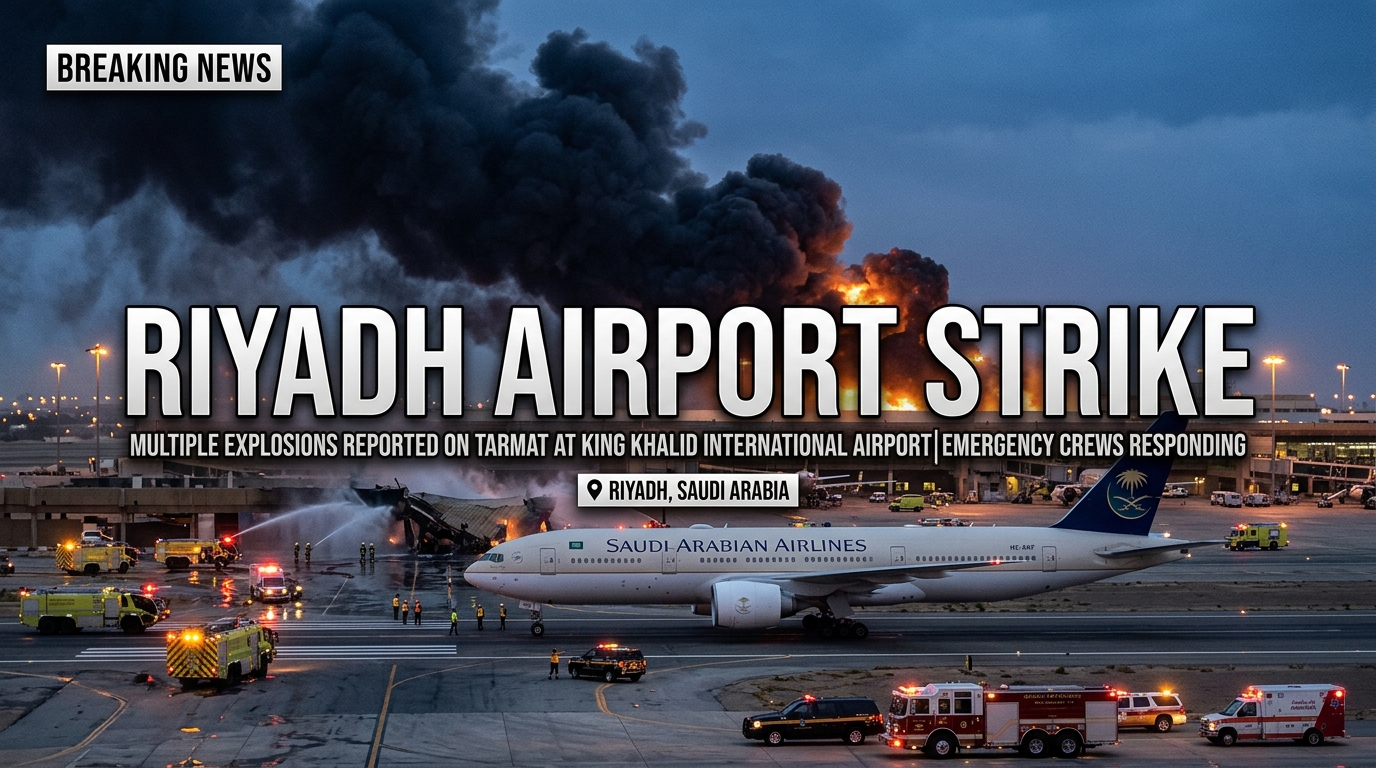
On the afternoon of October 8, 2026, the fragile illusion of normality across the Persian Gulf’s premier transit hubs was shattered when Yemen’s Houthi movement launched a coordinated ballistic missile salvo directly targeting King Khalid International Airport (RUH) in Riyadh. Plumes of dense black smoke billowed across the airport perimeter after an empty commercial airliner on the tarmac was caught in the concussive blast and shrapnel field.
While Saudi air defense batteries engaged incoming targets above the capital, falling debris rained down onto civilian neighborhoods, inflicting structural damage on a medical complex and a local kindergarten. Within hours, flight tracking boards turned into a sea of red: nearly 50% of scheduled departures were abruptly cancelled, triggering emergency flight suspensions from Europe to South Asia.
| Operational Impact & Carrier Responses | Incident Verification & Timeline |
|---|---|
| Target Facility | King Khalid International Airport (RUH), Riyadh, Saudi Arabia |
| Claimed Perpetrator | Ansar Allah (Houthi Movement, Yemen) |
| Ground Incident | Stationary commercial aircraft caught fire / sustained shrapnel damage |
| Lufthansa Group Response | Complete suspension of Riyadh flights through October 16, 2026 |
| Indian Carriers (Air India, IndiGo, Akasa) | Multi-day cancellations through October 9–10, 2026; Flight AI 925 diverted mid-air |
| Civilian Debris Damage | Medical complex and kindergarten in metropolitan Riyadh |
| Expat Community Affected | Over 2.5 million Indian nationals in Saudi Arabia under embassy alert |
Black Smoke Over Runway 33: The Tarmac Panic at King Khalid International
Eyewitness footage verified across social platforms showed passengers inside Terminal 2 screaming as loud secondary explosions echoed through the boarding gates. Ground crew scrambled away from the apron as a stationary jetliner billowed thick, acrid black smoke into the afternoon sky.
Saudi civil aviation officials confirmed that while fire crews brought the apron blaze under control within 35 minutes and prevented loss of life aboard the empty aircraft, the psychological threshold had been decisively breached. For decades, Gulf petrostates built their economic diversification strategies on becoming the world’s most reliable civil aviation crossroads. Having incoming ballistic ordnance detonate inside the security perimeter of the Kingdom’s principal gateway strikes at the heart of that economic architecture.
Aviation Corridor Paralysis: Why Air India, IndiGo, and Lufthansa Pulled the Plug
The airline industry’s reaction was swift and uncompromising. Air India Flight AI 925, en route from New Delhi to Riyadh, was ordered by flight dispatchers to make an immediate mid-air U-turn over the Arabian Sea, returning to India as Saudi airspace controllers initiated ground stops. Both IndiGo and Akasa Air followed within minutes, suspending all passenger and freight services into Riyadh through at least October 10.
European carriers enacted even harsher containment measures. Germany’s Lufthansa Group announced an immediate eight-day blackout on all services to Riyadh through October 16, redirecting widebody fleets around the Arabian Peninsula altogether.
“When ordnance makes physical impact on airport aprons, airline hull war insurance premiums multiply tenfold overnight,” explained aviation risk analyst Marcus Weber. “Airlines cannot justify exposing $150 million airframes and hundreds of passengers to ballistic envelope debris. If Riyadh’s airspace is deemed contested, the entire Red Sea and Gulf flight routing network crumbles into unprofitability.”
In New Delhi, the Ministry of External Affairs and the Indian Embassy in Riyadh issued urgent safety advisories to the 2.5 million Indian expats residing in Saudi Arabia, urging citizens to avoid non-essential travel around critical infrastructure hubs and maintain continuous contact with consular hotlines.
(Responsive / Native Ad)
The Interceptor Paradox: How Falling Shrapnel Pierced Capital Infrastructure
The attack has reignited a critical military debate over the limits of kinetic air defense systems in hyper-dense urban centers. Saudi Arabia operates some of the world’s most advanced Patriot PAC-3 and THAAD interceptor batteries. Yet, intercepting high-velocity hypersonic or ballistic warheads at terminal velocity does not make explosive mass disappear into thin air.
Military forensics in Riyadh revealed that heavy kinetic shrapnel from pulverized warheads and interceptor booster stages cratered roofs in residential districts north of the airport, tearing through the facade of a pediatric clinic and a kindergarten. Urban warfare analysts term this the “interceptor paradox”: even when an air defense battery performs with near-100% telemetry success, the supersonic debris field generated over a city of 7 million people inevitably produces severe surface casualties and structural devastation.
The General Munir Dilemma: Pakistan Troops and the Shifting Gulf Defense Umbrella
The escalating vulnerability of Saudi airspace coincides with seismic geopolitical maneuvering behind closed doors. Just hours before the strike, reports confirmed that Pakistan Army Chief General Asim Munir had bypassed his country’s civilian parliament to deploy additional Pakistani combat units and air-defense advisors to Saudi Arabia under expanding bilateral security arrangements.
With Saudi Arabia seeking ground and anti-drone reinforcements, Islamabad is stepping directly into the line of fire. However, the presence of foreign defense forces on Saudi soil introduces explosive political friction across the Islamic world, especially as domestic opposition parties in Pakistan denounce the deployment as dragging the country into a regional quagmire without democratic oversight.
Diplomatic Limbo: Trump’s November Midterm Clock and Tehran’s Calculated Leverage
Underpinning the escalating strikes is an intensifying geopolitical countdown in Washington. Former U.S. President Donald Trump publicly declared this week that the United States would not execute retaliatory strikes against Iran or regional proxies prior to the November 3 midterm elections, signaling an aversion to spiking domestic gasoline prices before voters head to the polls.
Regional analysts argue that Tehran-aligned actors recognized this 26-day political window as prime operational space. By testing Saudi defenses and throttling commercial aviation corridors while Washington remains politically paralyzed, the Houthis have demonstrated that Gulf airspace can be made unsafe at will. Until regional security frameworks establish a verifiable diplomatic settlement, the world’s busiest air corridors will remain one siren away from total shutdown.