 Hot
Hot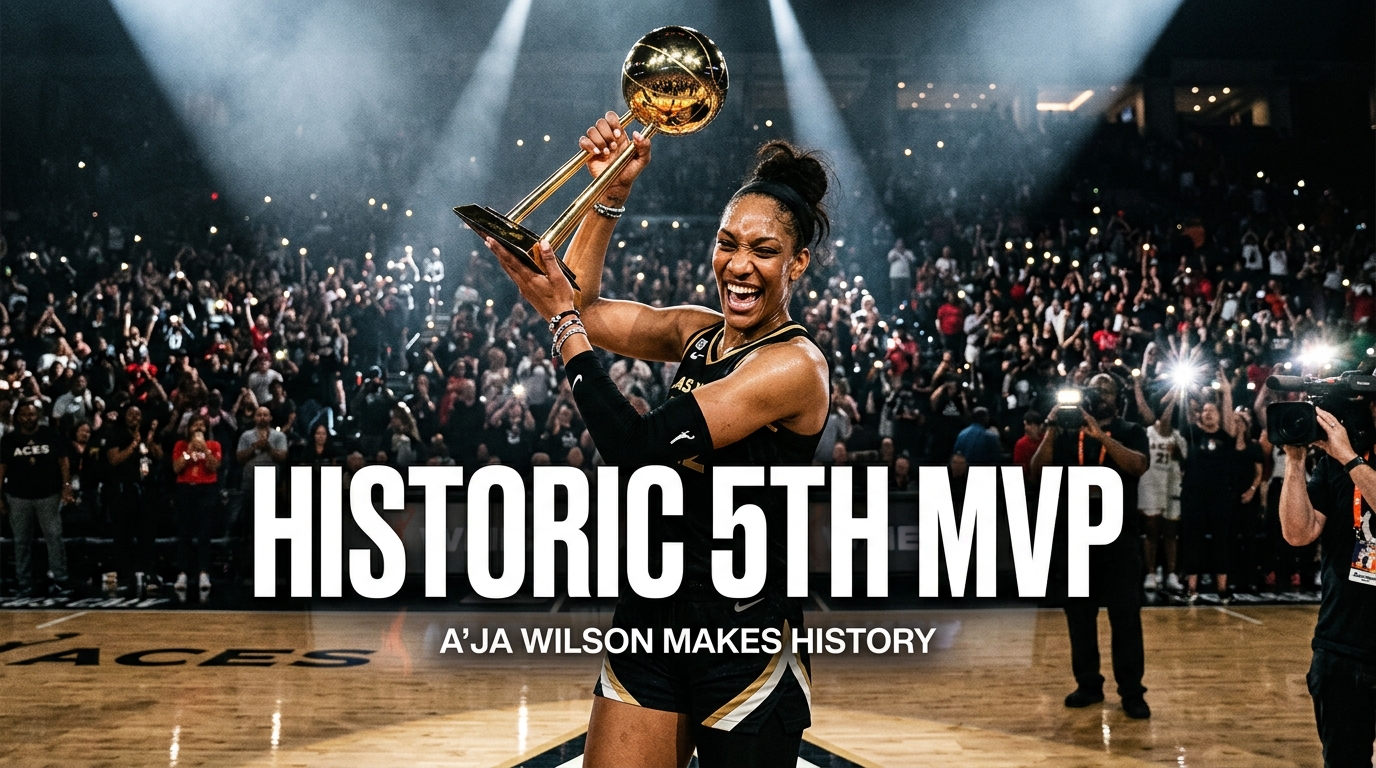
On the morning of October 8, 2026, the Women’s National Basketball Association confirmed what statistical dominance had long foreshadowed: A’ja Wilson was voted the 2026 WNBA Most Valuable Player. The triumph marks Wilson’s fifth MVP trophy and her third consecutive honor, elevating her into the most exclusive pantheon in professional basketball history alongside Kareem Abdul-Jabbar, Michael Jordan, and Bill Russell.
Yet within hours of the announcement, what should have been an undisputed coronation evolved into an explosive referendum on the league’s media machinery. Wilson stunned observers by quietly informing league officials that she would forgo the customary center-court pregame trophy presentation ahead of Game 3 against the Golden State Valkyries. Simultaneously, the public disclosure of the voting tallies sent shockwaves through sports analytics and fan communities: Indiana Fever sensation Caitlin Clark, who finished fourth overall, was completely omitted from 19 out of 74 national ballots.
The Pantheon Threshold: Matching Jordan and Kareem in Total Dominance
Wilson’s campaign across the 2026 season obliterated existing thresholds for modern interior play. Averaging 27.4 points, 12.1 rebounds, and 2.6 blocks per contest while shooting above 54% from the floor, she anchored both the league’s most efficient offense and its top-ranked paint defense. By securing 65 of the 74 available first-place votes, Wilson accumulated 713 points, leaving runner-up Olivia Miles (442 points) and teammate Kelsey Mitchell (287 points) in distant contention.
Her fifth award places her alone atop women’s basketball history, surpassing four-time winners Sheryl Swoopes, Lisa Leslie, and Lauren Jackson. For the Las Vegas Aces franchise, Wilson has transitioned from generational cornerstone to an immortal institutional force.
The Empty Midcourt Presentation: Why Wilson Sacrificed the Trophy Spotlight
Wilson’s refusal to participate in the traditional midcourt trophy ceremony—ordinarily a lavish television spectacle orchestrated by broadcast rights-holders—signals a deliberate shift in player agency. Sources close to the Aces locker room confirmed Wilson viewed the scheduled ceremony as an unnecessary distraction during a cutthroat postseason semi-final series.
Instead of posing with corporate executives under confetti before tip-off, Wilson prioritized defensive walkthroughs and locker room focus. The decision reflects an acute exhaustion with performative league celebrations at a time when competitive parity has made every playoff possession precarious. By turning down the spotlight, Wilson delivered an unmistakable message: individual accolades are secondary to a fourth championship ring.
The 19-Ballot Void: How Omission Math Exposed Media Bias and Gatekeeping
While Wilson’s victory was overwhelming, the voting architecture beneath her exposed an acrimonious ideological divide among accredited journalists.
(Responsive / Native Ad)
Caitlin Clark finished in fourth place with 212 total points, capturing one first-place vote, six second-place votes, 20 third-place votes, 16 fourth-place votes, and 12 fifth-place votes. That mathematical breakdown revealed an extraordinary fact: across 74 accredited media voters, 19 voters left Clark entirely off their top-five ballots.
| Player | 1st Place Votes | 2nd Place Votes | 3rd Place Votes | Total Points |
|---|---|---|---|---|
| A’ja Wilson (LVA) | 65 | 8 | 1 | 713 |
| Olivia Miles (CHI) | 6 | 42 | 14 | 442 |
| Kelsey Mitchell (IND) | 2 | 12 | 26 | 287 |
| Caitlin Clark (IND) | 1 | 6 | 20 | 212 |
| Breanna Stewart (NYL) | 0 | 4 | 9 | 171 |
For an athlete who led the league in assists per game, ranked in the top five in total scoring, and shattered multiple single-season playmaking records, the notion that 25.6% of accredited voters did not consider her among the five best players in the league has incited ferocious criticism. Analysts across ESPN and independent analytics collectives pointed out that omitting Clark could only be explained by subjective penalization, lingering resentment toward incoming fan demographics, or deliberate anti-hype gatekeeping.
The Generational Schism Reshaping WNBA Commercial Power
The 2026 MVP results encapsulate the broader culture war roiling women’s professional sports. On one flank stands the veteran core and long-time media custodians, defensive of traditional hierarchies and determined to emphasize two-way defensive rigor. On the other flank is an unprecedented surge of commercial capital, viewership records, and mainstream cultural attention driven by transformational perimeter playmakers.
When nearly a quarter of the electorate refuses to validate quantifiable offensive dominance, the legitimacy of closed-door media voting comes under intense scrutiny. Calls are already mounting for the WNBA Players Association (WNBPA) to demand either full ballot transparency—where every voter’s completed sheet is published immediately alongside on-record justification—or the incorporation of weighted player and coaching ballots in future collective bargaining agreements.
Wilson cemented her basketball immortality on the hardwood, but the voting fallout ensures that the 2026 MVP race will be remembered as the breaking point for how women’s basketball arbitrates greatness in the modern media era.