 Hot
Hot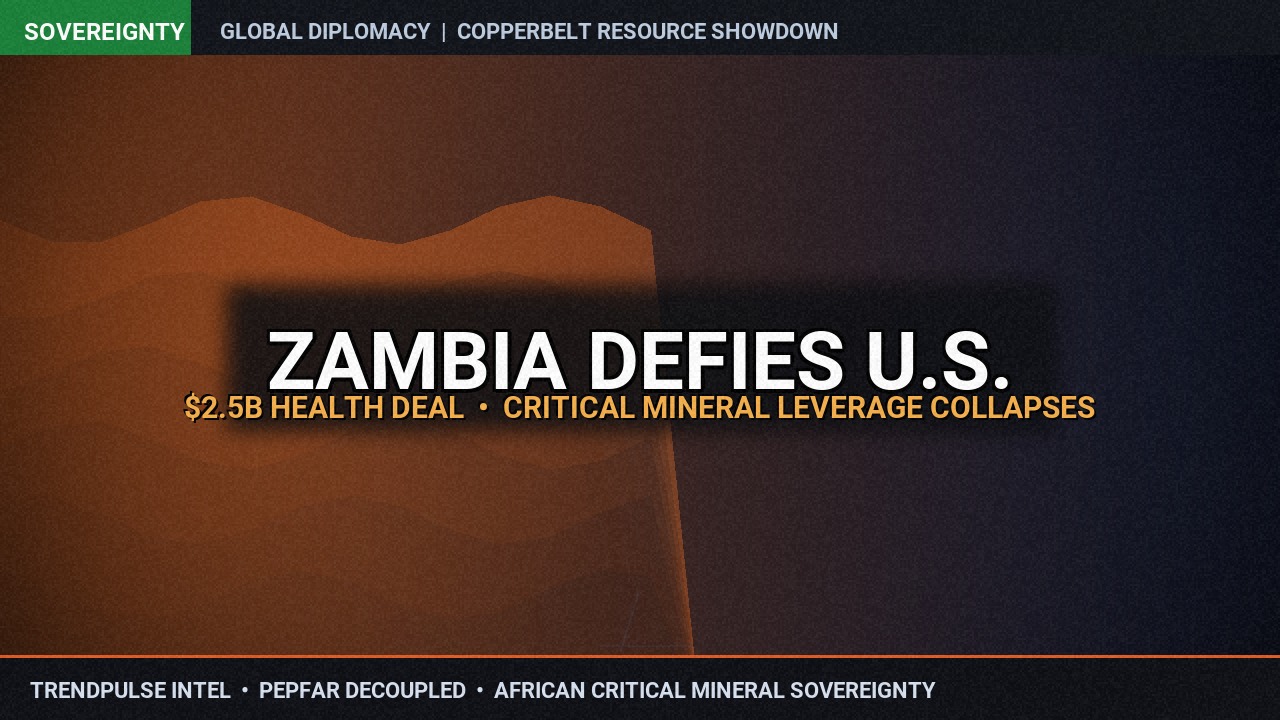
After ten months of high-stakes diplomatic standoff that pushed bilateral relations to the brink, the United States and Zambia officially signed a landmark five-year, $1.514 billion health cooperation agreement in Lusaka on Thursday. Paired with a historic $975 million domestic co-financing pledge from the Zambian government, the resulting $2.49 billion partnership secures essential funding for the President’s Emergency Plan for AIDS Relief (PEPFAR), tuberculosis eradication, malaria treatment, and maternal mortality reduction.
Yet behind the ceremonial handshakes lies an extraordinary victory for African diplomatic sovereignty. Zambian Minister of Foreign Affairs Mulambo Haimbe confirmed at the signing ceremony that Lusaka had successfully forced Washington to completely “decouple” health funding from aggressive U.S. demands for preferential access to Zambia’s vast critical mineral reserves and controversial patient biodata-sharing mandates. By standing firm against Washington’s transactional “America First Global Health Strategy,” Zambia has drawn a definitive red line against what African leaders and civil society coalitions condemned as 21st-century “resource blackmail.”
The Mineral Extortion Playbook: How Lifesaving ARVs Were Tied to Copper and Cobalt Racks
The roots of the standoff began in late 2025, when U.S. negotiators introduced unprecedented conditionalities into standard bilateral health memoranda. As the global scramble for clean energy transition metals accelerated—driven by electric vehicle battery manufacturing, military electrification, and artificial intelligence data center power grids—the White House sought to leverage Zambia’s acute dependence on external HIV assistance to outmaneuver Beijing across the Central African Copperbelt.
Under the initial draft text, Washington proposed conditioning hundreds of millions in annual PEPFAR support on Zambia granting U.S. firms fast-tracked mining licenses and preferential export quotas for high-grade copper, cobalt, and lithium deposits. Even more contentious were sweeping clauses requiring Zambian public hospitals to transfer raw patient health registries and physical biological specimens directly to American research repositories.
| Negotiating Dimension | Initial U.S. Demand (2025–2026) | Final Sovereign Treaty (Oct 2026) |
|---|---|---|
| Critical Mineral Linkage | Mandatory mining concessions & export quotas | 100% Decoupled; relegated to separate commercial talks |
| Genomic & Specimen Export | Direct export of biological specimens & biobanks | Stripped entirely; specimens remain under Zambian control |
| Health Data Sovereignty | Broad access to national patient registries | Restricted strictly to program performance metrics |
| Financial Burden-Sharing | Unilateral U.S. grant oversight | Co-investment: $1.514B (US) + $975M (Zambia) |
| Multilateral Precedent | Transactional aid template for Africa | Historic defeat for resource-tied development aid |
“Conditioning pediatric antiretrovirals and malaria nets on copper concessions was an unconscionable breach of basic international humanitarian norms,” Minister Haimbe stated in an address following the signing. “Zambia’s health policy belongs to the Zambian people, and our sovereign subsoil belongs to our national future. We refused to barter our children’s healthcare for our natural heritage.”
The Lobito Corridor Calculus: Why the White House Was Forced to Blink
Washington’s eventual retreat was driven by hard geopolitical realism. Over the past three years, the United States and European allies poured billions into the Lobito Corridor—a flagship rail and infrastructure project designed to transport minerals from Zambia and the Democratic Republic of Congo directly to Angola’s Atlantic port of Lobito, bypassing Chinese-controlled shipping lanes to the Indian Ocean.
Had the United States allowed the health agreement to collapse, the resulting political blowback threatened to fatally compromise President Hakainde Hichilema’s pro-Western diplomatic stance and push Zambia directly into Beijing’s embrace. Chinese state-owned enterprises, already heavily embedded in Zambia’s northern copper belts, stood ready to step in with alternative healthcare infrastructure grants through South-South cooperation frameworks.
(Responsive / Native Ad)
Recognizing that overplaying its hand risked alienating one of its most critical democratic partners in Africa, the State Department blinked. High-ranking U.S. diplomats quietly stripped the extraction and specimen transfer clauses, reframing the final agreement around mutual health system strengthening while shunting mineral discussions into independent, non-coercive trade working groups.
A New Precedent for the Global South: The Death of Coercive Resource Diplomacy
The outcome in Lusaka reverberates far beyond Zambia’s borders. For emerging economies across sub-Saharan Africa, Latin America, and Southeast Asia, the agreement demonstrates that developing nations possess unprecedented bargaining power in an era of critical mineral scarcity.
Global health advocates from Health GAP and the African Vaccine Manufacturing Initiative hailed the treaty as a watershed moment for data sovereignty and bioethics. As low- and middle-income nations face accelerating pressure from major powers seeking raw materials for green technologies, Zambia’s successful defiance establishes an essential precedent: humanitarian partnerships cannot be weaponized as commercial leverage.
By holding the line against the superpower in Washington, Lusaka demonstrated that national health and resource sovereignty are not mutually exclusive—and that in the new multipolar order, African nations will no longer be dictated to at the negotiating table.