 Hot
Hot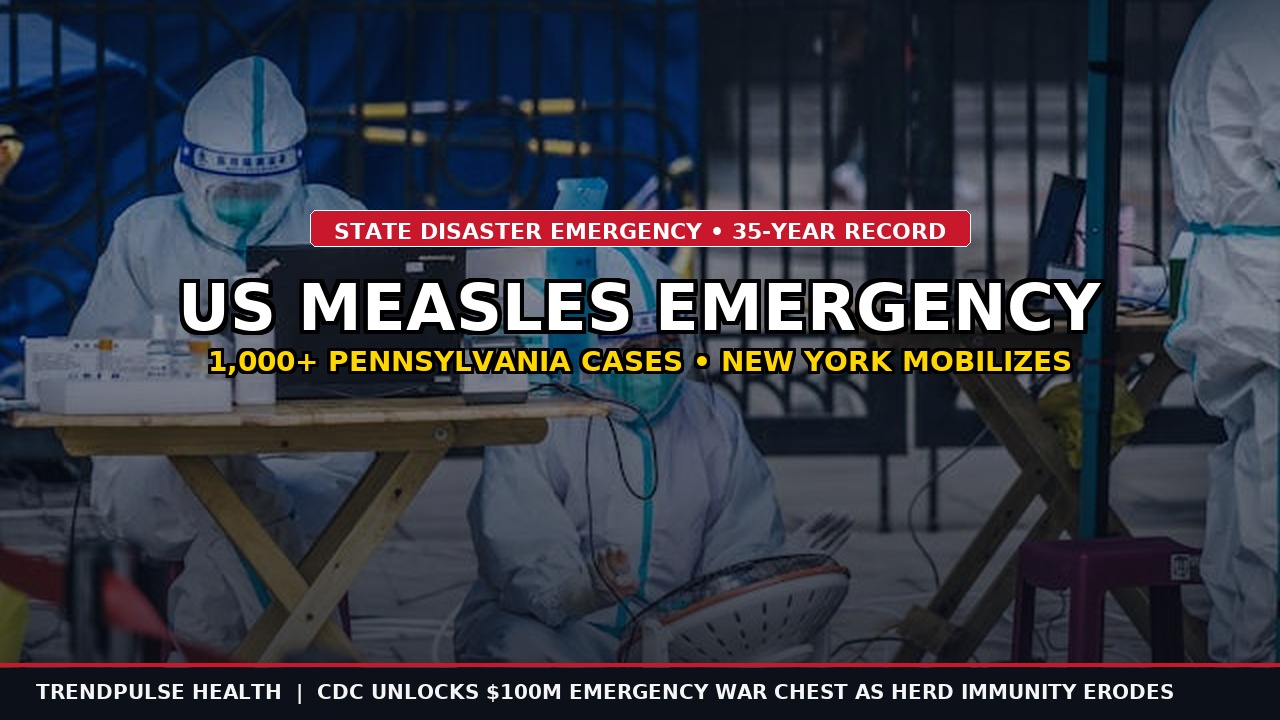
In what public health officials are describing as the most severe epidemiological regression in a generation, the United States is confronting its largest domestic measles outbreak in over 35 years. The crisis reached a critical inflection point on October 8, as the Pennsylvania Department of Health confirmed that statewide infections have climbed to 1,078 cases across 41 counties, resulting in 207 hospitalizations and five tragic deaths.
Hours later, neighboring New York Governor Kathy Hochul signed an executive order declaring a State Disaster Emergency, responding to 108 cases clustered across 18 rural and suburban counties. The declaration temporarily bypasses standard statutory restrictions, empowering paramedics, pharmacists, midwives, and advanced emergency medical technicians to administer the MMR (measles, mumps, and rubella) vaccine while granting registered nurses emergency authority to order diagnostic panels. In southeastern Pennsylvania, Chester County’s Oxford Area High School abruptly suspended all in-person classes after an unimmunized student tested positive, triggering contact-tracing alerts spanning hundreds of households.
The Centers for Disease Control and Prevention (CDC) moved quickly to unlock $100 million in emergency contingency grants, dispatching rapid-response epidemiological strike teams to Harrisburg and Albany as pediatric intensive care units report surging occupancy rates.
| Outbreak Metric | Pennsylvania Epicenter | New York State Response | National Benchmark / Baseline |
|---|---|---|---|
| Confirmed Case Count | 1,078 active cases across 41 counties | 108 cases across 18 counties | Highest U.S. total since the 1989–1991 resurgence |
| Hospitalization Rate | 19.2% (207 admissions, 5 fatalities) | 14.8% (16 admissions, 0 fatalities) | Historic severe complication average: ~10–15% |
| Vaccination Profile | >99% unimmunized or single-dose incomplete | >96% unimmunized | Target herd immunity threshold: 95% two-dose MMR |
| Executive Action Taken | School closures, quarantine orders in 3 districts | State Disaster Emergency declared through Nov 4 | CDC deployed $100M emergency containment fund |
| Healthcare Mobilization | National Guard medical units on standby | Paramedics, pharmacists granted MMR injection authority | Pediatric ICU surge capacity triggered regionally |
The Lancaster Epicenter and the Erosion of Rural Herd Immunity
Epidemiologists trace the current crisis to a persistent, widening tear in the fabric of community immunity. For decades, the United States maintained a nationwide two-dose MMR coverage rate safely above the 95% threshold required to prevent the airborne paramyxovirus from sustaining transmission chains. However, across rural enclaves—most acutely in Pennsylvania’s Lancaster and Lebanon counties—kindergarten vaccination compliance has steadily deteriorated over the past four years, dropping below 82% in several localized school districts.
Measles is widely recognized as one of the most contagious human viruses in existence, carrying a basic reproduction number ($R_0$) between 12 and 18. Once introduced into an undervaccinated cluster, the pathogen spread with ruthless efficiency. Because the virus can remain suspended in aerosolized droplets for up to two hours after an infected individual departs a room, standard hygiene measures proved utterly insufficient. County clinics that spent years treating zero cases were suddenly inundated with pediatric patients presenting with high fevers, Koplik’s spots, and debilitating respiratory distress.
The Legal and Logistical Scramble: Mobilizing Paramedics While Florida Loosens Guardrails
Governor Hochul’s emergency declaration underscores how desperate state health authorities have become to erect artificial firewalls before the Pennsylvania caseload bleeds irreversibly into New York’s metropolitan corridors. By deputizing paramedics and pharmacists to give childhood immunizations on demand, Albany is attempting to meet working families outside traditional primary care offices. Mobile vaccination vans are now stationed at commuter rail hubs and rural community centers from Binghamton to Sullivan County.
(Responsive / Native Ad)
Yet this aggressive mobilization stands in stark, ideological contrast to policy shifts unfolding elsewhere in the country. In Tallahassee, the Florida Department of Health held heated public hearings this week debating proposed rule revisions that would expand non-medical exemptions for standard school immunizations. Public health scholars warn that this deepening state-level divergence is creating a balkanized public health landscape. As interstate travel remains entirely unrestricted, an outbreak incubated in rural Pennsylvania or supported by weakened statutes in the South can trigger cascading containment expenditures in the Northeast within forty-eight hours.
Losing ‘Elimination Status’: What CDC’s $100 Million Emergency Means for Pediatric Healthcare
Beyond the immediate scramble to contain classroom exposures, the outbreak threatens a profound symbolic and regulatory blow to American medicine: the loss of the nation’s official measles elimination status, granted by the World Health Organization in 2000. Under international epidemiological protocols, if continuous, chains of transmission persist across American soil for more than twelve consecutive months, the United States will be formally reclassified as an endemic zone.
Such a downgrade carries far-reaching consequences. Travel advisories issued by European and Asian governments could recommend extra boosters for tourists visiting affected U.S. regions, while domestic health insurers face tens of millions in preventable inpatient care costs. More critically, pediatric hospitals—already stretched thin by autumn respiratory syncytial virus (RSV) and early influenza admissions—now face the daunting prospect of managing specialized negative-pressure isolation wards. As federal health officials disperse emergency funds and scramble to trace exposures across school gymnasiums and church assemblies, the crisis serves as a stark reminder: when a society lets down its scientific guard, defeated diseases don’t simply fade away—they strike back.