 Hot
Hot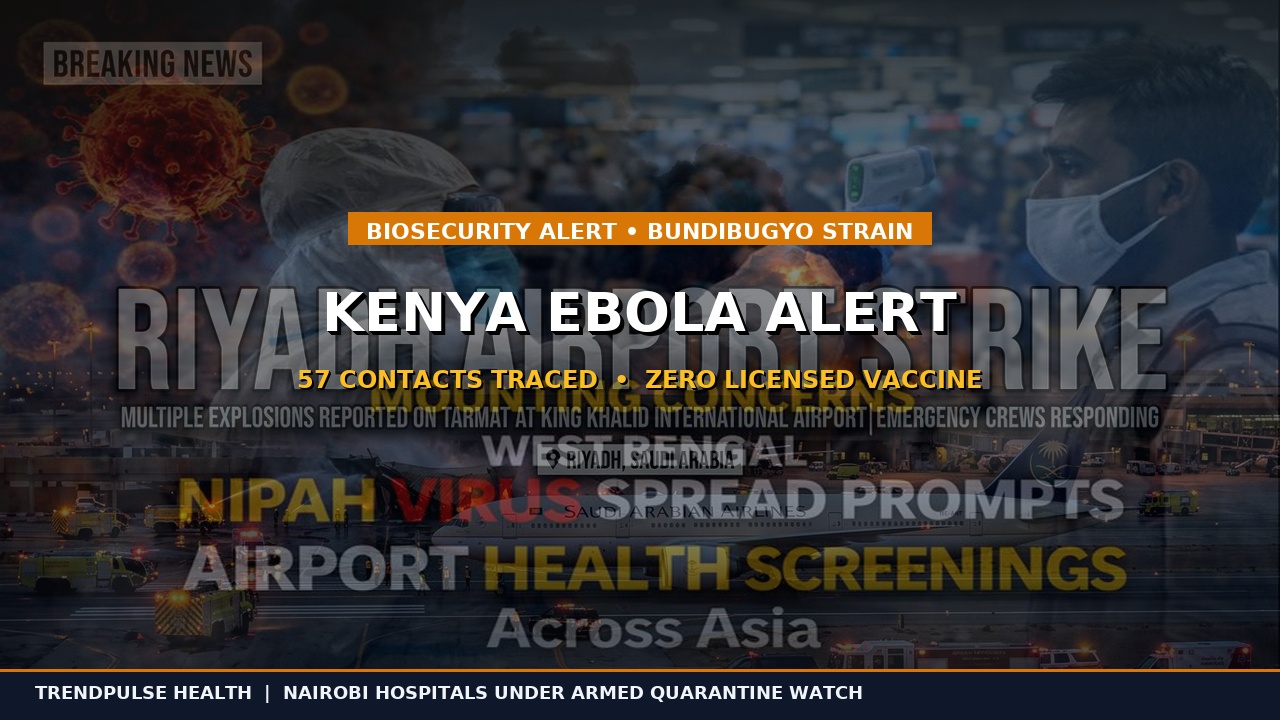
East African health authorities have been placed on high alert after Kenya confirmed its first-ever case and fatality from the Bundibugyo ebolavirus, an uncommon and lethal hemorrhagic fever strain. The landmark case has prompted urgent contact tracing operations across multiple international transit hubs, piercing the illusion of post-pandemic border biosecurity in one of the continent’s most bustling economic corridors.
According to the Kenyan Ministry of Health and the World Health Organization (WHO), the index patient was a Kenyan national who had been residing in the Democratic Republic of the Congo (DRC) for several years. After developing feverish symptoms in eastern DRC, the individual traveled overland across the border into Uganda before boarding a scheduled commercial flight directly into Nairobi on October 3. Although isolated shortly after arriving at a specialized medical facility in Nairobi, the patient succumbed to the infection on the night of October 5.
Kenya’s Director General for Public Health confirmed that 57 primary and secondary contacts have been identified across flight manifests, customs staff, taxi drivers, and initial healthcare workers. At least 10 high-risk contacts are currently quarantined under strict armed guard at the National Police Service Hospital in Nairobi for the requisite 21-day incubation window.
| Crisis Metric | Operational Finding | Regional Implications |
|---|---|---|
| Ebolavirus Species | Bundibugyo ebolavirus (Rare Central African strain) | No approved commercial vaccine (Ervebo ineffective) |
| Transmission Transit Path | DRC (Overland) ➔ Uganda ➔ Commercial Flight ➔ Nairobi | Multi-border biosecurity screening failure |
| Contact Tracing Scope | 57 individuals traced (flight crew, border agents, medics) | High risk of secondary urban community exposure |
| Quarantine Facility | National Police Service Hospital, Nairobi | 10 high-risk individuals isolated for 21-day window |
| Aviation & Trade Hub Risk | Jomo Kenyatta International Airport (JKIA) | Threat of regional travel curbs and quarantine mandates |
The Vaccine Blind Spot: Why Standard Countermeasures Cannot Stop Bundibugyo
The primary clinical alarm reverberating through the WHO and the Africa Centres for Disease Control (Africa CDC) stems from the specific viral species responsible for the death. While global health systems celebrated the historic deployment of Ervebo (the rVSV-ZEBOV vaccine) to conquer recent outbreaks in West Africa and the DRC, that licensed vaccine protects strictly against the Zaire ebolavirus.
Against the Bundibugyo strain, Ervebo and existing monoclonal antibody cocktails (such as Inmazeb and Ebanga) offer zero cross-protective efficacy.
Because Bundibugyo outbreaks are historically rare—having emerged primarily in western Uganda in 2007 and the DRC’s Orientale Province in 2012—multinational pharmaceutical developers have never pushed a Bundibugyo candidate through complete Phase 3 clinical trials. If secondary community transmission escapes the quarantine perimeter in densely populated Nairobi, healthcare workers on the frontline will be fighting the pathogen entirely without approved vaccines or targeted antiviral therapeutics, relying strictly on supportive hydration and symptom management.
The Transit Corridor Dilemma: How an Infected Traveler Crossed Three Borders
The index patient’s odyssey reveals glaring structural vulnerabilities along the Great Lakes transit corridor. Despite widespread temperature screening monitors installed during the COVID-19 and Mpox emergencies, the asymptomatic or mild incubation period of early Ebola infection allows symptomatic travelers to slip past passive border checks.
(Responsive / Native Ad)
By transiting overland from eastern DRC into Uganda and subsequently boarding a passenger aircraft at Entebbe bound for Jomo Kenyatta International Airport (JKIA), the traveler navigated multiple international checkpoints without tripping automated thermal alarms.
JKIA serves as East Africa’s preeminent aviation nexus, connecting dozens of flights daily to Europe, the Middle East, and Asia. If passengers sharing the flight cabin or baggage claim queues contracted the virus, the potential for geographic dispersion expands exponentially. Epidemiological teams in Kampala and Kinshasa are now racing against time to interview every bus conductor, immigration clerk, and baggage handler who interacted with the traveler along the thousand-kilometer route.
Economic Panic Over Africa’s Busiest Commercial Hub
Beyond the immediate medical emergency, the confirmation of an Ebola fatality on Kenyan soil strikes at the core of the nation’s economic engine. Kenya represents the financial, diplomatic, and logistical heart of East Africa, relying heavily on international tourism, horticultural air cargo exports, and foreign direct investment.
During previous Ebola flare-ups in neighboring Uganda, regional trade suffered immediate disruptions as neighboring borders slapped mandatory freight quarantines and testing levies on cross-border truckers. Kenyan trade associations have already voiced panic that neighboring states or international aviation regulators might impose flight restrictions or travel advisories targeting Nairobi.
While government spokespeople have stressed that the situation is strictly an imported, isolated event rather than an active domestic outbreak, the coming 14 days will determine Kenya’s public health trajectory. If all 57 quarantined and monitored contacts test negative as their incubation windows expire, Nairobi will have dodged a catastrophic bullet. But if fever spreads among the quarantined officers at the National Police Service Hospital, East Africa will find itself facing a biosecurity nightmare for which the global medicine cabinet remains dangerously unprepared.