 Hot
Hot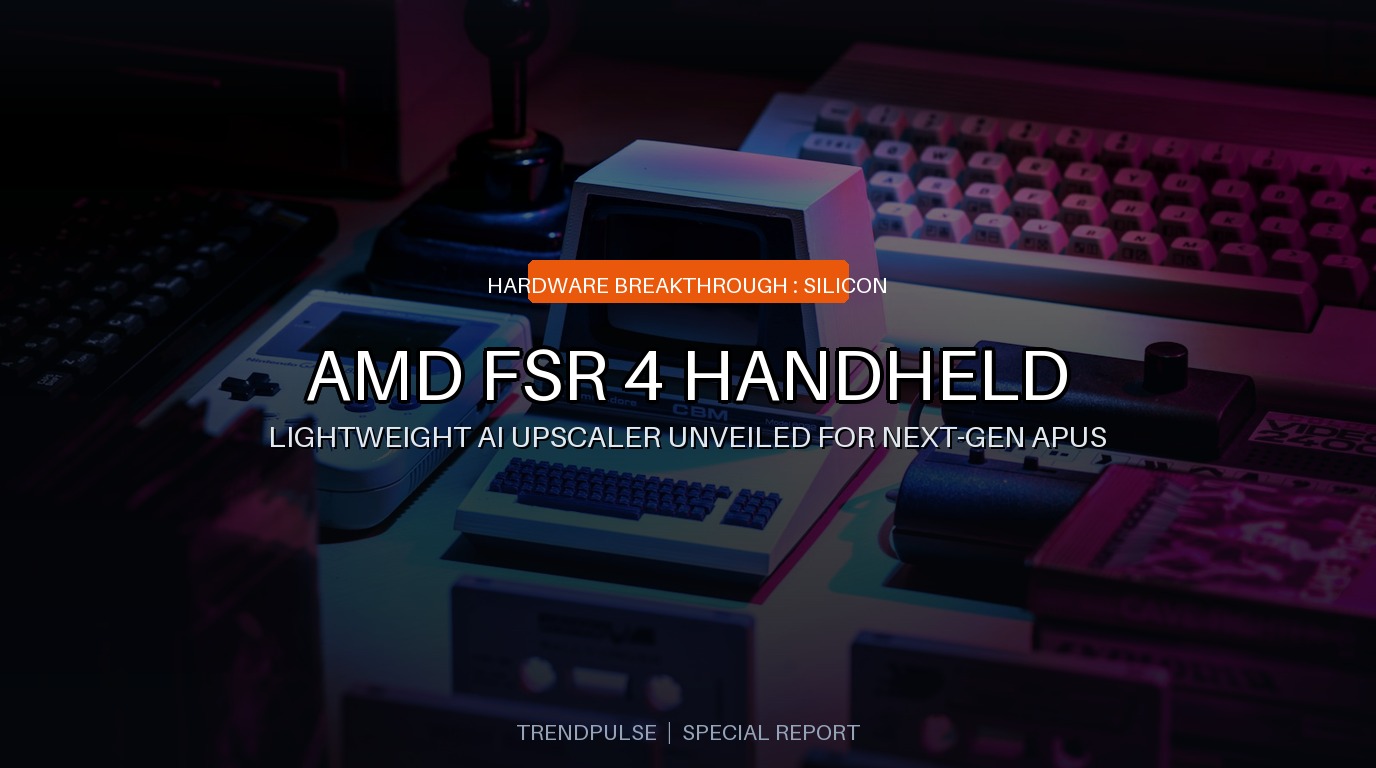
In a decisive move to solidify its grip on the burgeoning portable PC market, AMD has confirmed that a specialized, lightweight model of FidelityFX Super Resolution 4 (FSR 4) is currently in development and targeted for deployment across handheld consoles, gaming laptops, and accelerated processing units (APUs) before the end of 2026.
Speaking in technical briefings monitored by Digital Foundry, AMD Senior Vice President and Computing and Graphics General Manager Jack Huynh revealed that while flagship FSR 4 neural models were architected for high-wattage desktop Radeon RX 9000 and RX 7000 discrete GPUs, low-power integrated graphics require a fundamentally re-engineered inference pipeline. Rather than forcing constrained 15W–30W APUs to run full-weight convolutional neural networks, AMD’s hardware team has pruned and quantized the architecture into an ultra-lean inference model tailored for constrained memory bandwidth and tight battery budgets.
| Technical Specification & Roadmap | Desktop FSR 4 Standard | Handheld & APU Lightweight FSR 4 |
|---|---|---|
| Target Power Envelope (TDP) | 120W – 350W+ Discrete GPUs | 9W – 35W Integrated APUs |
| Model Architecture | Full-parameter Neural Frame Synthesizer | Quantized, Low-Latency ML Weight Pruning |
| Compute Execution Unit | Dedicated FP16 / Matrix Cores | Hybrid NPU / Shared RDNA SIMD Pipeline |
| Primary Platform Targets | Radeon RX 9000 / RX 7000 Desktops | Steam Deck successors, ROG Ally, Legion Go |
| Target Release Window | Available across Desktop Discrete GPUs | Rolling out to APUs & Handhelds by late 2026 |
| Key Competitive Advantage | Native visual parity with Nvidia DLSS 3.7 | Preserves 2–3 hour handheld battery runtimes |
The Thermal Envelope Paradox: Why Desktop AI Models Break Handhelds
The engineering hurdle facing handheld gaming is governed by brutal thermodynamic reality. While desktop graphics cards have the luxury of drawing hundreds of watts to compute machine-learning reconstructions in milliseconds, mobile gaming handhelds operate inside strict 15-watt systems where CPU, GPU, memory, and display compete for every milliwatt.
When the modding community previously attempted to inject heavy, unoptimized machine-learning upscaling algorithms into devices like the ASUS ROG Ally or Lenovo Legion Go, frame rates often stabilized at the cost of catastrophic battery drainage and soaring SoC thermals. Running heavyweight matrix multiplication operations directly on mobile compute units creates compute congestion, starving the rasterization engine of execution cycles.
By developing a dedicated lightweight inference graph, AMD aims to execute temporal reconstruction and neural edge anti-aliasing within microsecond budgets, offloading portions of the mathematical tensor workload to dedicated Neural Processing Units (NPUs) on modern Strix Point silicon without cannibalizing frame presentation times.
Valve, Microsoft, and the Battle for the Next-Gen Handheld Silicon
AMD’s announcement arrives at a pivotal inflection point in portable computing. With Valve actively designing next-generation iterations of its hardware ecosystem and persistent industry reports that Microsoft is collaborating with hardware partners on a dedicated Xbox handheld, silicon efficiency has superseded brute rasterization performance as the primary battlefield.
“Upscaling is no longer an optional performance booster in the handheld space—it is the foundational architecture making modern Unreal Engine 5 games playable on a 7-inch display,” explains hardware analyst Kian Forrester. “If AMD can deliver clean, temporal stability with zero ghosting at 1080p while sipping power, it effectively locks in its status as the exclusive silicon partner for the entire handheld gaming industry.”
Mid-Article Ad Space
(Responsive / Native Ad)
Furthermore, the lightweight FSR 4 initiative serves as a protective moat against Intel’s XeSS, which has gained traction for its robust fallback modes on non-Intel hardware, and looming competitive pressure from Qualcomm’s Snapdragon X architecture, which continues to court portable PC makers with superior ARM battery endurance.
Backward Compatibility Uncertainty: Will Older RDNA 2 Handhelds Be Left Behind?
While Huynh confirmed AMD’s commitment to supporting both existing APU lineups and upcoming product stacks, significant ambiguity remains regarding older architectures. Hardware enthusiasts and millions of original Steam Deck owners are keenly watching whether the custom Van Gogh APU (built on older RDNA 2 silicon lacking dedicated AI acceleration instructions) will receive official driver-level optimization.
Industry engineers speculate that while RDNA 3 and RDNA 3.5 architectures (such as the Z1 Extreme and Ryzen AI 300 series) will handle lightweight FSR 4 natively through INT8 and FP16 optimizations, older handhelds may require software-fallback emulation that could blunt efficiency gains. AMD has pledged to publish exact hardware compatibility matrices closer to its release window.
Bridging the Mobile Fidelity Gap Heading Into 2027
As modern blockbuster titles increasingly mandate hardware ray tracing and heavy shader pipelines, the portable PC market cannot rely on brute silicon shrinks alone to achieve playable performance.
By tailoring FSR 4 directly to the physics of handheld devices, AMD is making a critical philosophical shift: treating mobile upscaling not as a compromised downscaling of desktop tech, but as a specialized, first-class computational discipline. If Jack Huynh’s team executes the roadmap as promised before the close of 2026, handheld gamers may finally achieve the holy grail of portable gaming—console-grade image stability without watching battery percentages plummet by the minute.