 Hot
Hot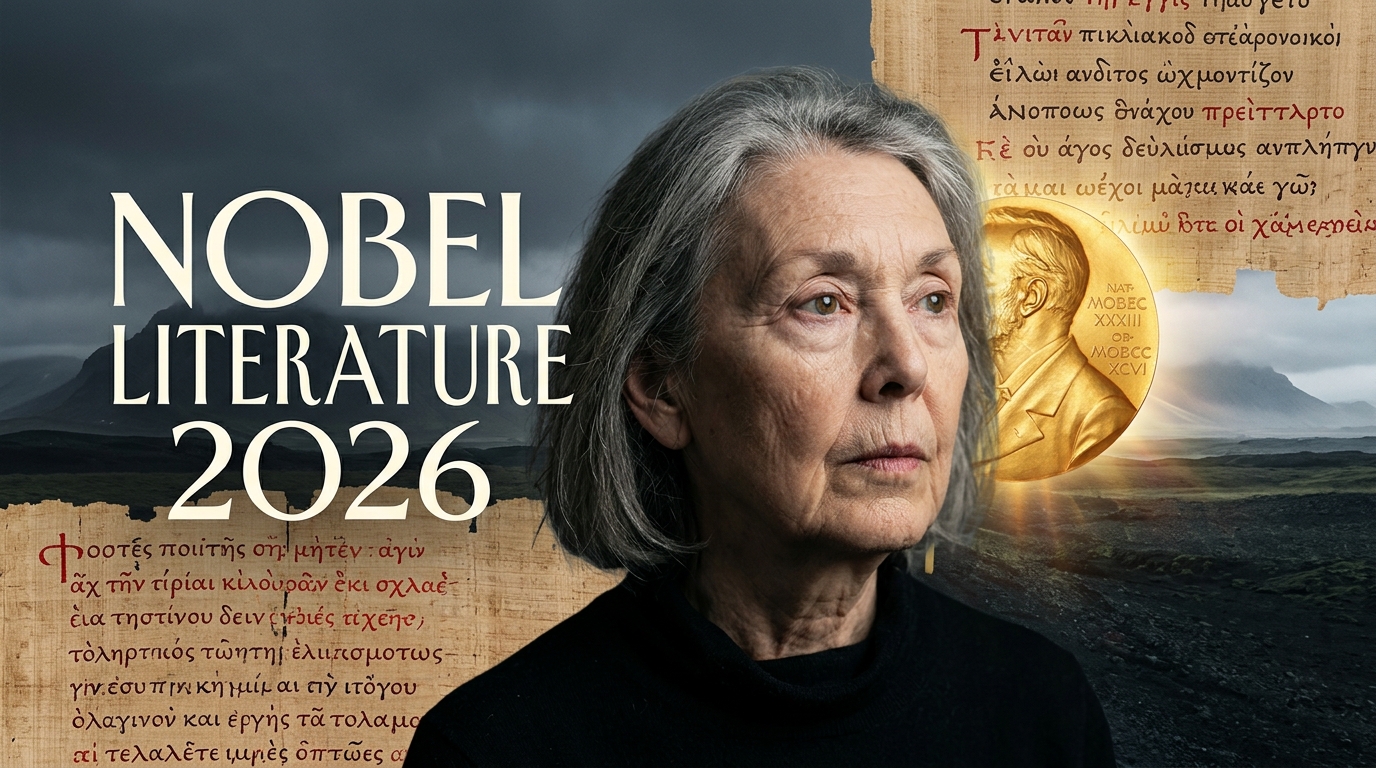
In a decision celebrated across international literary circles for honoring intellectual daring and formal invention, the Swedish Academy announced in Stockholm on October 8, 2026, that the 2026 Nobel Prize in Literature has been awarded to Canadian poet, essayist, and translator Anne Carson.
The Academy honored the 76-year-old classicist “for her bold and inventive oeuvre that, in playful dialogue with the classical tradition, has created new forms for contemporary literature.” Carson becomes the 18th woman and only the second Canadian author—following short-story master Alice Munro in 2013—to receive the world’s most prestigious literary laurel, accompanied by a prize of 11 million Swedish kronor (approximately $1.06 million).
| Literary Milestone | Details & Official Swedish Academy Citations |
|---|---|
| 2026 Nobel Laureate | Anne Carson (Born June 21, 1950, Toronto, Ontario, Canada) |
| Academy Citation | “For her bold and inventive oeuvre that, in playful dialogue with the classical tradition, has created new forms for contemporary literature” |
| Historical Precedent | 18th female laureate in Literature; 2nd Canadian recipient after Alice Munro (2013) |
| Defining Masterpieces | Eros the Bittersweet (1986), Autobiography of Red (1998), The Beauty of the Husband (2001), Nox (2010), Float (2016) |
| Key Translation Feats | If Not, Winter: Fragments of Sappho, Euripides’ Grief Lessons, Sophocles’ Antigonick |
| Prize Purse | 11 million Swedish kronor (~$1.06 million USD) |
Sweeping the Floor in Reykjavík: An Unvarnished Reaction to Stockholm’s Call
While literary betting parlors and international critics had debated Carson’s candidacy for more than a decade, the news reached the author in characteristically unpretentious circumstances. Carson was at her home in Reykjavík, Iceland, quietly sweeping her kitchen floor when her telephone began ringing incessantly.
Speaking with Icelandic national broadcaster RÚV shortly after Permanent Secretary Ingrid Carlberg announced the citation, Carson offered a characteristically dry, disarming reaction:
“I think they’re all crazy,” Carson remarked with dry humor, describing the official phone call from Stockholm as “rather halting” because the committee asked “the usual questions, and I had no answers.”
When asked how she intended to spend the historic day, Carson declined grand media appearances, stating she would turn off her devices and walk through the Icelandic woods with her husband and collaborator, Robert Currie, to “hear the quiet.”
The Winged Monster in Red: How ‘Autobiography of Red’ Rewrote the 20th-Century Novel
Carson’s crowning by Stockholm represents a profound ideological victory for experimental literature over conventional narrative realism. Trained as a rigorous classical philologist with a doctorate from the University of Toronto, Carson refused to treat ancient Greek poets—Sappho, Stesichoros, Euripides, and Homer—as static museum relics. Instead, she revitalized ancient fragments as living, urgent vessels for modern heartbreak, grief, and erotic vulnerability.
Her 1998 verse masterpiece, Autobiography of Red: A Novel in Verse, remains the central pivot of modern narrative poetry. Taking a few surviving fragments by the Greek lyric poet Stesichoros about Geryon—a red, winged monster slain by Herakles—Carson transposed the mythological beast into a sensitive, photography-obsessed modern adolescent growing up in suburban Canada, navigating an agonizing romance with Herakles against volcanic landscapes. By dissolving the demarcation lines separating lyric poetry, literary criticism, translation, and novelistic drama, Carson proved that modern storytelling could invent its own hybrid grammar without sacrificing narrative suspense or emotional devastation.
(Responsive / Native Ad)
The Accordion of Grief: Reimagining the Materiality of the Book in ‘Nox’
Beyond reimagining genre, Carson systematically revolutionized the physical architecture of the book itself. Following the sudden death of her estranged brother Michael in 2000, Carson spent a decade crafting Nox (2010)—an accordion-folded facsimile housed inside a heavy gray slipcase.
Weaving together Catullus’s Elegy 101 (Multas per gentes et multa per aequora vectus), handwritten journal entries, family snapshots, dictionary lexical entries, and collaged scrap paper, Nox was not merely read; it was unfolded like an archaeological scroll. Carson demonstrated to the digital generation that the printed codex could function as an intimate tomb, a tactile reliquary where grief resists neat narrative resolution.
The Publishing Scramble and the Global Rediscovery of Classical Humanism
Stockholm’s selection triggered an immediate frenzy across global publishing houses on Thursday afternoon. Independent presses such as New Directions in New York, McClelland & Stewart in Toronto, and Jonathan Cape in London reported instant sell-outs across Carson’s catalog, initiating emergency six-figure reprint runs for out-of-print experimental works including Glass, Irony and God, The Beauty of the Husband, and Float.
More significantly, the award marks a calculated philosophical shift by the Swedish Academy. After years of alternating between documentary reporting, introspective memoir, and politically pointed fiction, the Nobel Committee has endorsed a writer whose entire artistic architecture rejects ideological reductionism.
In an era saturated by algorithmic content and fragmented digital attention spans, Anne Carson’s Nobel triumph reaffirms that the deepest questions of human consciousness—how we grieve, how desire unmoors us, and how language both reveals and conceals the self—remain inextricably bound to the timeless, fractured whispers of the ancient world.