 Hot
Hot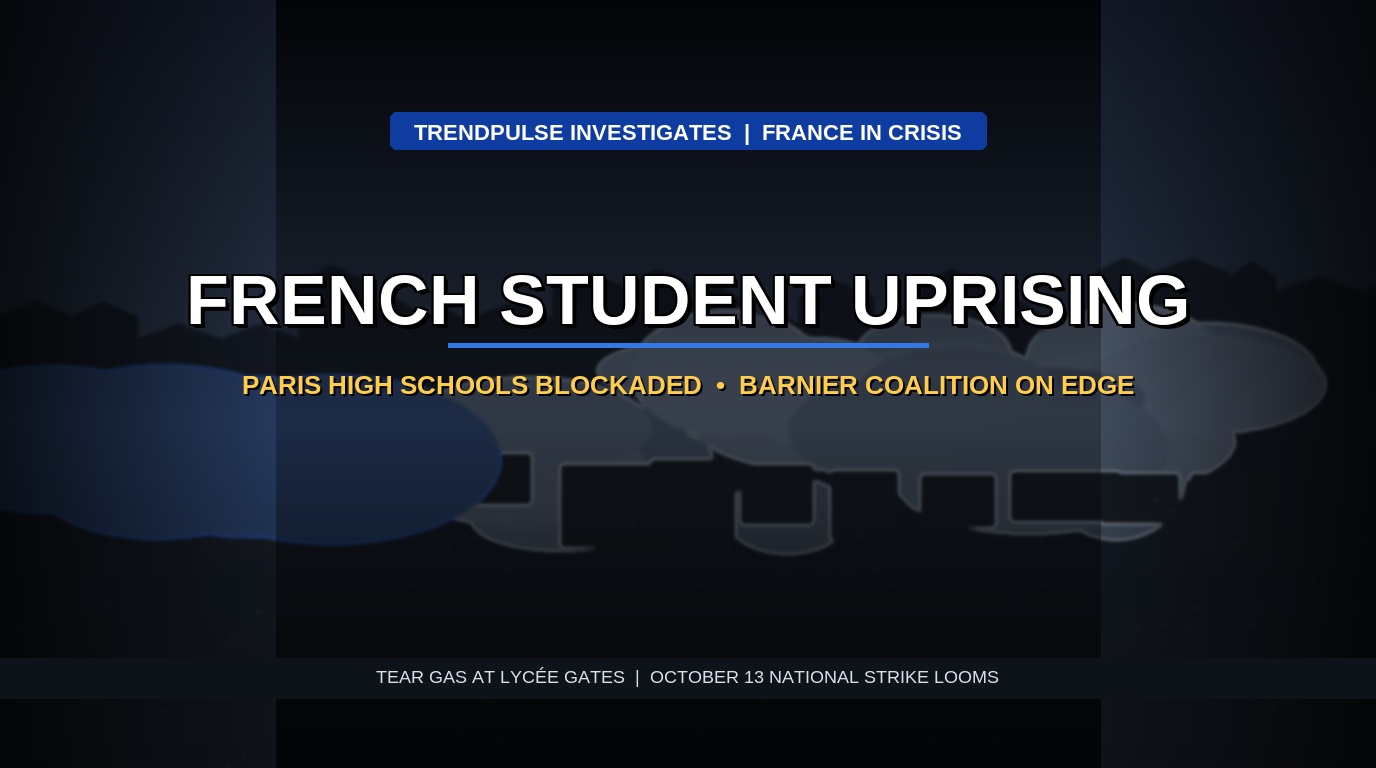
Plumes of acrid white tear gas drifted across the iconic boulevards of eastern Paris on October 8, 2026, as thousands of high school and university students staged their second day of mass walkouts in less than a week. Barricades constructed from wheelie bins, construction barriers, and rental bicycles barricaded the gates of prestigious Parisian lycées—including Hélène Boucher, Voltaire, and Sophie Germain—before spillover demonstrations clogged the Place de la Bastille and Place de la République.
While French student mobilization has a storied lineage stretching back to May 1968, the current explosion of youth fury is rapidly evolving into a systemic existential crisis for the nascent, fragile government of Prime Minister Michel Barnier.
Cobblestones, Garbage Bins, and Acrid Smoke: The Lycée Revolt Escalates
What began in mid-September as sporadic regional demonstrations against crumbling secondary school infrastructure has transformed into a coordinated national rebellion. In Lyon, Marseille, Lille, and Nantes, high school syndicates joined forces with university student unions, shutting down campus access and marching side-by-side with secondary teachers.
Outside Lycée Hélène Boucher in the 20th arrondissement of Paris, tensions reached a boiling point early Thursday morning when municipal refuse collectors joined students, constructing fortified blockades across surrounding avenues. Chants of “Barnier démission!” echoed off Haussmannian facades as mobile brigades of the CRS (Compagnies Républicaines de Sécurité) deployed tear gas canisters and pressurized water cannons to disperse teenagers huddled behind cardboard protest signs.
Flash-Balls Against Minors: The Heavy-Handed Policing Doctrine Under Scrutiny
The tipping point in the public consciousness, however, has not been the student demands themselves, but the aggressive state response directed at minors. Over the past fortnight, social media channels have been flooded with footage of teenage demonstrators pinned to pavements, struck by batons, and engulfed in CS gas.
The confrontation escalated dramatically after a 15-year-old student in northern France suffered severe facial trauma from an impact munition, forcing the Interior Ministry to issue an emergency temporary ban on stun grenades during student assemblies. But rights monitors argue the concession is cosmetic:
- Amnesty International France issued a blistering statement citing “alarming and disproportionate force,” highlighting the deployment of rubber-bullet launchers (LBDs) and chemical irritants against crowds largely comprised of 14- to 17-year-olds.
- The Defender of Rights (Défenseur des Droits) initiated three independent inquiries into arbitrary student detentions and physical brutality at school perimeter gates.
- Parent-Teacher Associations (FCPE) publicly accused the police prefecture of treating adolescents exercising civic rights as hostile rioters.
The poignant slogan sprayed across Parisian lycée walls—“Trop jeunes pour voter, assez vieux pour être gazés” (Too young to vote, old enough to be tear-gassed)—has resonated far beyond student circles, crystallizing growing public anger over state authoritarianism.
(Responsive / Native Ad)
The Austerity Dilemma: Dilapidated Classrooms in Barnier’s Deficit Drive
Beneath the fury at police tactics lies a deep structural grievance: the suffocating impact of national austerity. Tasked with slashing France’s ballooning budget deficit to comply with European Union fiscal caps, the Barnier administration’s proposed 2026 austerity blueprint imposes stringent budget freezes across public education:
| Critical Factor | Student & Union Demands | Barnier Government Budget Reality |
|---|---|---|
| Teaching Positions | Urgent recruitment of 5,000+ certified educators | Net reduction of 4,000 teaching posts nationwide |
| Classroom Sizing | Hard cap at 24 students per secondary class | Classes regularly exceeding 32–35 students |
| Infrastructure Funding | €2.5B emergency fund for heating, asbestos removal | Capital repair budgets frozen across regional councils |
| Special Needs Support | Full integration and living wage for AESH aides | Minimal adjustments with part-time contracting |
Secondary students are enduring unheated winter classrooms, cancelled specialized tracks, and chronically absent teachers who cannot be replaced due to hiring freezes. For France’s youth, the state appears eager to finance riot suppression gear while disinvesting from their educational future.
The Countdown to October 13: A Fragile Coalition on the Brink
The momentum is accelerating toward a decisive flashpoint. A coalition of youth organizations, including the USL (Union Syndicale Lycéenne) and FIDL, has declared an open-ended national general strike set for Tuesday, October 13, 2026, openly backed by major national trade unions (CGT and FSU).
For Michel Barnier, the danger cannot be overstated. Operating without an absolute majority in the National Assembly, his government survives entirely at the mercy of rival opposition blocs. If the street mobilizations of school pupils coalesce with wider public sector strikes against pension and social security freezes, the left-wing Nouveau Front Populaire and Marine Le Pen’s Rassemblement National could find mutual incentive to table a no-confidence motion.
In France, historic governments have repeatedly fallen or retreated when students take the streets. As barricades smolder in Paris, the Barnier administration faces a stark ultimatum: de-escalate police tactics and negotiate education investments, or risk being swept away by a generation that cannot vote, but has proven it can paralyze the nation.