 Hot
Hot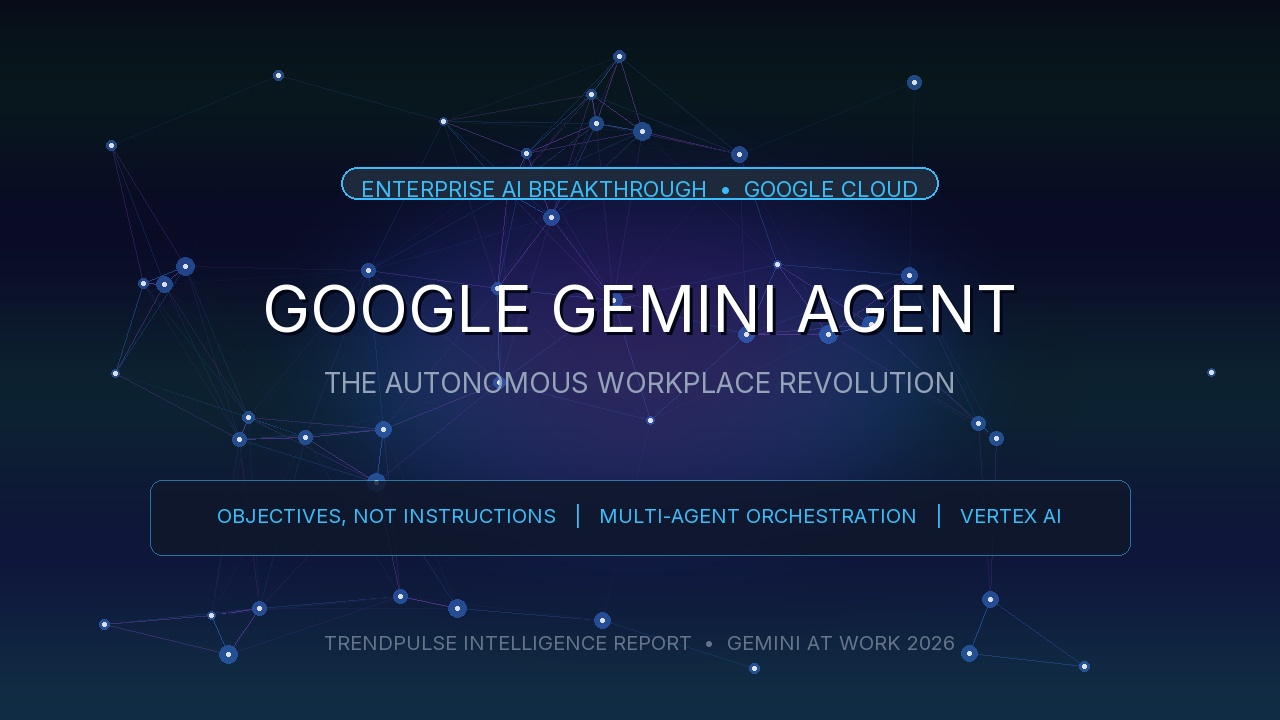
In what enterprise analysts are calling the most decisive operational pivot in corporate computing since the advent of cloud SaaS, Google Cloud on October 8, 2026, officially launched the Gemini agent at its annual Gemini at Work 2026 summit.
Positioned not as a conversational assistant or drafting chatbot, but as an autonomous digital worker, the Gemini agent operates on a foundational shift in enterprise software: “Objectives, Not Instructions.” Rather than requiring employees to craft micro-prompts for every document summary or data lookup, enterprise users can assign overarching business objectives—such as auditing quarterly procurement contracts against ERP billing records, reconciling supply chain bottlenecks, or orchestrating incident response protocols. The agent autonomously formulates the execution plan, writes and debugs necessary scripts, and interacts across enterprise software silos to deliver finished outcomes.
| Core Architectural Capabilities | Gemini Agent vs. First-Generation Enterprise AI Assistants |
|---|---|
| Interaction Paradigm | Prompt-by-prompt conversational copilot ➔ Goal-directed autonomous objective execution |
| Execution Horizon | Ephemeral, single-session chat replies ➔ Persistent multi-day memory and background execution |
| Sub-Agent Orchestration | Monolithic single-model processing ➔ Spawns dynamic task-specific sub-agents to divide operations |
| Model Routing Engine | Locked to proprietary stack ➔ Hybrid routing across Gemini Ultra/Flash and Anthropic Claude via Vertex AI |
| Software Integrations | Restricted to Google Workspace ➔ Cross-platform access: Google Workspace, Microsoft 365, Slack, Salesforce, Jira |
| Enterprise Security Guardrails | Static permission prompts ➔ Zero-trust policy enforcement, cryptographically audited identity verification |
The Death of the ‘Prompt Assistant’: Why Autonomous Objective Execution Changes Everything
For the past three years, the corporate rollout of generative AI has suffered from a plateau known internally across Fortune 500 IT departments as “the prompt fatigue barrier.” Tools like Microsoft 365 Copilot and early iterations of Gemini Workspace required constant human intervention: employees had to instruct the model what to write, check each paragraph, copy data manually from spreadsheets, and verify citations individually.
The new Gemini agent dismantles this friction by introducing dynamic sub-agent orchestration. When assigned a complex mandate—for instance, evaluating vendor compliance for Honeywell or Shopify—the primary Gemini agent breaks down the problem into discrete micro-tasks, automatically instantiating isolated sub-agents to read PDFs in Google Drive, query inventory metrics in SAP, cross-reference pricing in Salesforce, and assemble a presentation deck in Google Slides without human intervention at each step.
By decoupling human supervision from mechanical data assembly, Google is transforming knowledge workers from frontline doers into executive supervisors of autonomous AI swarms.
The Hybrid Cloud Coup: Weaponizing Anthropic Claude Inside the Google Ecosystem
Perhaps the most aggressive strategic decision unveiled by Google Cloud CEO Thomas Kurian was the agent’s model-agnostic routing framework. Rather than restricting customers exclusively to Google’s proprietary Gemini family of models, the Gemini agent features native, dynamic model routing that integrates Anthropic’s Claude 3.5 and Sonnet models directly within the enterprise workflow via Vertex AI.
This open architectural posture addresses a long-standing corporate anxiety: vendor lock-in. Enterprise CTOs who previously balked at committing their core operations solely to Google’s AI models can now run hybrid pipelines—routing code generation to specialized reasoning models while deploying Gemini Flash for massive context retrieval and media synthesis.
The tactical move puts immediate pressure on Microsoft, whose Copilot remains tightly anchored to OpenAI’s infrastructure, and Salesforce, whose proprietary Agentforce platform charges aggressive per-conversation premiums.
(Responsive / Native Ad)
The Liability Chasm: Who Is Legally Responsible When Autonomous Agents Make Mistakes?
While early corporate adopters including PayPal, On, and Honeywell report substantial productivity gains, legal and compliance scholars warn that the shift to autonomous execution opens a perilous governance void.
Unlike a chatbot that merely suggests text for a human editor to review, an autonomous agent granted read-write access to corporate data lakes, email servers, and financial software can make kinetic decisions: executing trades, modifying vendor agreements, or updating enterprise code repositories. If a hallucination or logic flaw leads an agent to breach a regulatory covenant or inadvertently leak non-public financial disclosures, existing corporate liability frameworks remain unprepared.
Google has attempted to preempt these corporate anxieties by introducing enterprise-grade cryptographic audit trails and deterministic permission fences. Yet as these autonomous agents begin interacting with third-party APIs and rival agents across supplier networks, the risk of cascading algorithmic failures will test the boundaries of corporate insurance and enterprise compliance.
The White-Collar Horizon: Redefining the Entry-Level Career Ladder
As autonomous enterprise agents mature from experimental pilots into standardized corporate infrastructure, the economic implications for junior white-collar employment cannot be ignored. The routine administrative analysis, contract reconciliation, and slide deck preparation that traditionally served as the training ground for junior analysts, paralegals, and corporate associates are precisely the workloads the Gemini agent was built to eliminate.
Organizations adopting agentic architectures will inevitably face a structural paradox: hyper-efficient operational teams producing unprecedented output with leaner staff, counterbalanced by an urgent necessity to develop new training pathways for junior talent who can no longer learn the ropes through repetitive clerical work.
The arrival of Google’s Gemini agent marks the definitive end of the chatbot novelty era. The era of the autonomous enterprise co-worker has officially arrived—and corporate boardrooms must now adapt to a landscape where software no longer waits for commands, but executes missions on its own.