 Hot
Hot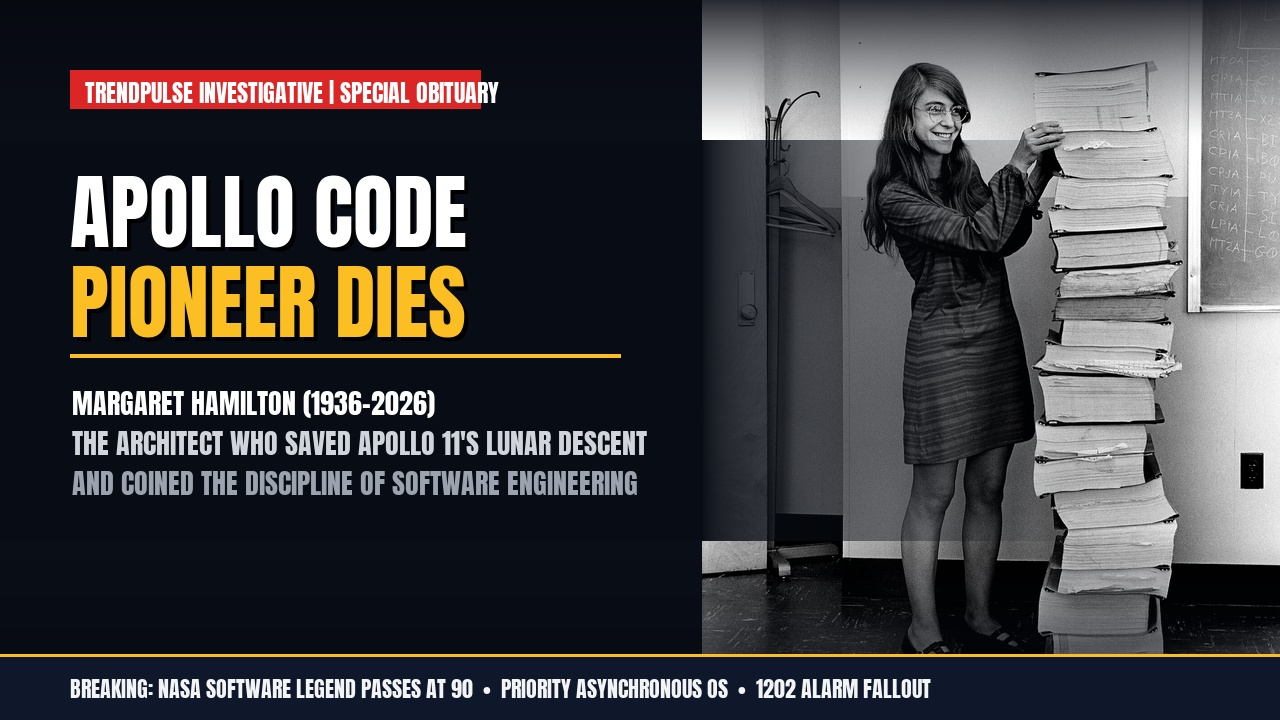
Margaret Hamilton, the trailblazing mathematician and computer scientist who led NASA’s software engineering team for the Apollo program and coined the phrase “software engineering” to compel a male-dominated aerospace establishment to respect digital code, died at age 90, the Massachusetts Institute of Technology (MIT) and NASA officially confirmed on October 8, 2026.
As Director of the Software Engineering Division at the MIT Instrumentation Laboratory, Hamilton was the architect behind the on-board guidance software for both the Apollo Command Module and the Lunar Module. In an era when programming was executed on physical paper punch cards and hand-woven into copper wire magnetic core memory—affectionately nicknamed “LOL” for “Little Old Lady memory”—Hamilton introduced rigorous mathematical validation that forever redefined mission-critical computing.
| Engineering Benchmark | The Hamilton Paradigm vs. Modern Enterprise Software |
|---|---|
| Mission Mandate | Zero-failure fault tolerance during life-or-death human spaceflight |
| Architectural Breakthrough | Asynchronous executive priority scheduling with automated task preemption |
| Memory Constraint | Just 72 kilobytes of read-only rope memory and 4 kilobytes of RAM |
| Verification Standard | Formal logical proof, exhaustive simulation, zero runtime crash tolerance |
| Historic Crisis Managed | The infamous 1202 and 1201 radar overloads during Apollo 11’s lunar descent |
| Presidential Honor | Awarded the Presidential Medal of Freedom by President Barack Obama in 2016 |
Three Minutes from Disaster: How the 1202 Alarm Forced Real-Time Priority Scheduling
On July 20, 1969, exactly three minutes before Neil Armstrong and Buzz Aldrin were scheduled to touch down on the lunar surface, the Apollo Guidance Computer (AGC) flashed error code 1202, followed seconds later by 1201. Inside Mission Control in Houston, flight controllers held their breath, their fingers poised over the manual abort switches that would have scrubbed mankind’s first moon landing.
The computer was experiencing a catastrophic hardware overload: an improperly set rendezvous radar switch was flooding the central processor with stolen cycle interrupts, overwhelming its capacity by over 15%. In any standard computer architecture of the 1960s—or indeed in many fragile web architectures today—the system would have suffered an unrecoverable stack overflow, freezing the flight instruments and hurtling the lunar module Eagle uncontrollably into the Moon.
Instead, the lander touched down safely with barely 25 seconds of fuel remaining. Hamilton’s revolutionary asynchronous executive priority scheduler had recognized the overload. Her software automatically shed low-priority housekeeping routines while strictly preserving high-priority critical tasks: firing the descent thrusters and computing the vehicle’s altitude vector.
“The computer was smart enough to recognize that it was being asked to perform more tasks than it should be performing,” Hamilton later reflected. “It dropped lower-priority tasks and only executed the ones essential to keep the astronauts alive.”
Inventing an Entire Discipline: When Male Hardware Engineers Mocked ‘Software’
When Hamilton arrived at MIT in the early 1960s as a young mother and self-taught programmer, software was treated as an afterthought—an administrative chore akin to typing or clerical filing. Hardware engineers designed physical circuits, rockets, and transistors; writing code was seen as secondary, unscientific, and low-prestige.
Hamilton pushed back aggressively against the institutional condescension of the engineering guild. She began using the term “software engineering” deliberately in technical briefings to demand parity with electrical and mechanical disciplines.
(Responsive / Native Ad)
“They used to make fun of me for using the word ‘engineering’ for code,” Hamilton recalled. “They said it wasn’t a real science. So I kept using it until they had to accept that software was an engineering discipline in its own right.”
Her insistence on treating code as an engineering science laid the philosophical and methodological foundations for decades of computer science curricula worldwide.
The Lost Gospel of Provable Correctness in an Era of Fragile AI
Hamilton’s passing arrives at a poignant, precarious moment in technological history. In the decade following Apollo, Hamilton founded Higher Order Software (HOS) and Hamilton Technologies, developing the Universal Systems Language (USL)—an ambitious formal methodology aimed at mathematically proving systems correct before a single line of code was executed. She believed software should be built with preventative, deterministic architecture rather than relying on reactive bug patches.
Today, Silicon Valley and global IT ecosystems operate on precisely the opposite ethos. The modern software lifecycle is dominated by “move fast and break things,” fragile continuous integration loops, opaque generative AI wrappers, and massive dependency bloat that regularly brings global aviation, banking, and emergency services to a halt—as demonstrated by recent widespread IT outages.
As artificial intelligence agents and black-box neural networks assume control over autonomous vehicles, defense systems, and healthcare diagnostics, the loss of Margaret Hamilton is more than the end of a legendary Apollo chapter. It serves as a stark reminder of what the computing world has compromised: the rigorous, fault-tolerant mathematical integrity that once carried humanity safely to the stars and back.