 Hot
Hot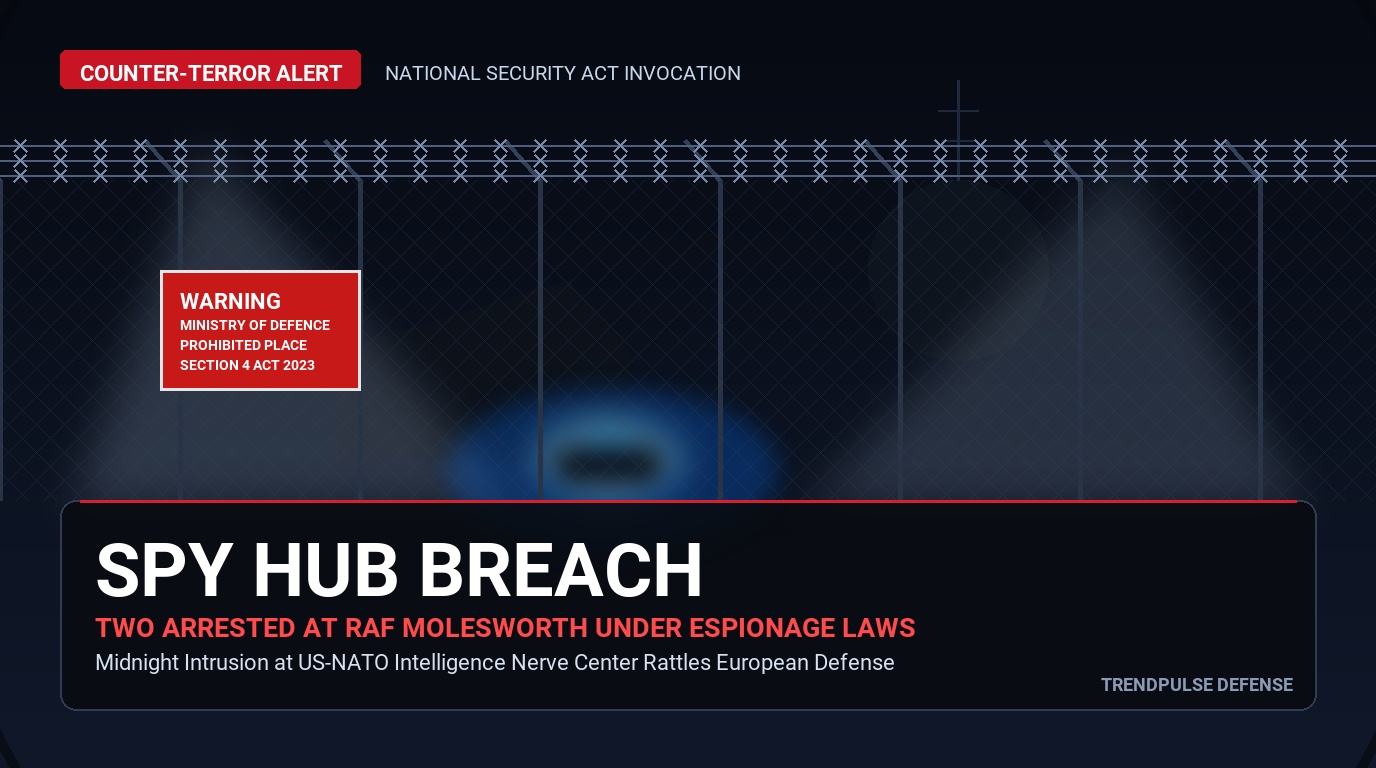
In the dead of night along an unlit country lane in Cambridgeshire, a routine Ministry of Defence Police patrol noticed an empty vehicle parked near the perimeter fencing of RAF Molesworth at 10:00 PM on Wednesday, October 7. Four hours later, at 2:00 AM on Thursday, armed security officers apprehended two Latvian nationals—aged 32 and 36—deep within the facility’s grounds. What initially appeared to be a bizarre trespass case was swiftly turned over to London Counter Terrorism Policing (CTP), which invoked Section 4 of the UK’s newly minted National Security Act 2023, triggering urgent inquiries across British and American defense commands.
Commander Helen Flanagan, head of CTP London, confirmed that detectives are currently executing intensive search warrants at two residential properties in the Peterborough area. While Flanagan emphasized that investigators are “keeping an open mind” and found no immediate connection to recent high-profile drone scares at RAF Fairford, the breach has ignited acute anxiety across NATO’s European intelligence apparatus.
Inside RAF Molesworth: The Joint Nerve Center Orchestrating Allied Intelligence
To the casual observer, RAF Molesworth resembles a sleepy relic of the Cold War. Unlike RAF Lakenheath or Mildenhall, no F-35 fighter jets or aerial refuelers scramble from its tarmac; the station decommissioned its active runways decades ago. Yet behind its razor-wire perimeter lies one of the most sensitive operational complexes in the Western alliance:
- Joint Intelligence Operations Center Europe Analytic Center (JAC): Operated by the United States European Command (EUCOM), the JAC synthesizes theater-level military intelligence across Eastern Europe, Russia, and the Middle East.
- NATO Intelligence Fusion Center (NIFC): An independent multinational intelligence hub providing real-time situational awareness directly to the Supreme Allied Commander Europe (SACEUR).
- U.S. Africa Command (AFRICOM) Intelligence Outpost: Houses forward-deployed analytical teams monitoring counter-terrorism and maritime movements across North and West Africa.
Because RAF Molesworth is an intelligence consolidation node rather than a combat airwing, its physical footprint was designed to rely on standoff perimeter sensors and passive barriers rather than the visible armed garrisons characteristic of nuclear-capable bases. That architectural subtlety makes any physical breach extraordinarily alarming for defense planners.
Invoking Section 4: How UK Counter-Terror Police Escalated from Trespass to State Espionage
The decisive inflection point occurred when investigators upgraded the initial charges of aggravated trespass and criminal damage to Section 4 of the National Security Act 2023. Passed by Parliament to modernize Britain’s century-old espionage laws against hostile state activities, Section 4 specifically criminalizes entering a prohibited place for a purpose prejudicial to the safety or interests of the United Kingdom.
| National Security Act 2023 vs. Legacy Official Secrets Act | Legacy Framework | National Security Act 2023 (Section 4) |
|---|---|---|
| Evidentiary Threshold | Required proof of explicit classified document theft | Covers mere unauthorized physical access to prohibited strategic sites |
| Maximum Penalty | Up to 2 years imprisonment for basic trespass | Up to 14 years imprisonment for foreign interference or espionage intent |
| Investigative Scope | Standard civilian police remand limits | Counter-terrorism detention powers, asset freezes, and warrantless device seizures |
| Hostile State Proxy Standard | Strict direct state employment required | Covers informal proxies, deniable cutouts, and third-party commercial contractors |
By deploying Section 4, British authorities unlocked sweeping counter-espionage powers. Digital forensics teams are currently scrutinizing smartphones, GPS loggers, encrypted messaging caches, and surveillance equipment seized from the suspects to determine whether their objective was physical reconnaissance, signals interception, or mapping secure fiber-optic conduits.
The 2:00 AM Discovery: An Abandoned Vehicle and a Cut Fence on the Cambridgeshire Perimeter
The physical sequence of the intrusion underscores how low-tech maneuvers can bypass modern electronic monitoring. Security officials disclosed that the intruders breached the wire via a localized fence cut, allowing them to remain on base grounds for at least four hours before apprehension.
(Responsive / Native Ad)
The presence of an abandoned vehicle outside the perimeter fence first alerted patrolling MoD officers. Defense analysts point out that had the intruders employed an off-site drop-off rather than leaving a conspicuous car on a rural roadside, their presence within the base might have gone undetected for considerably longer. The four-hour gap between vehicle discovery and physical capture has prompted the Ministry of Defence to launch an immediate audit of thermal camera coverage and ground sensor sensitivity along the base’s multi-kilometer perimeter.
The Hybrid Sabotage Playbook: Why Baltic Nationals Inside Allied Sites Ring Alarms
While British authorities maintain that the suspects’ motives remain under active investigation, European security agencies have spent the past eighteen months tracking a sophisticated campaign of deniable hybrid warfare orchestrated by foreign intelligence services. Across Poland, the Baltic states, Germany, and the UK, hostile networks have repeatedly recruited local nationals and migrant laborers for low-level tasks—ranging from photographing defense logistics hubs and railway junctions to arson attacks on warehouses.
Because the two detained men are Latvian nationals residing in the UK, intelligence analysts are investigating whether they were targeted by online foreign recruitment networks, operating under financial coercion, or acting independently. Regardless of the ultimate finding, the event fits squarely into the warning issued by MI5 and European domestic intelligence heads regarding the widespread deployment of deniable operatives against sensitive Western infrastructure.
The Physical Defense Reckoning: Hardening Britain’s Distributed Airfields Against Shadow Infiltrators
The fallout from the Molesworth breach extends far beyond Cambridgeshire. With defense facilities across the United Kingdom hosting shared American intelligence units, signals listening posts, and weapons stockpiles, the vulnerability of perimeter wire fencing to wire cutters and opportunistic penetration has sparked urgent calls in Westminster for upgraded security postures.
Allied airbases are now expected to implement continuous automated drone patrols, AI-driven perimeter fence vibration sensors, and expanded armed exclusion perimeters around intelligence-heavy facilities. As counter-terror teams comb through the searched addresses in Peterborough, the Molesworth incident serves as a stark reminder: in an era of geopolitical turbulence, NATO’s most guarded secrets are only as secure as the physical wire strung around them.