 Hot
Hot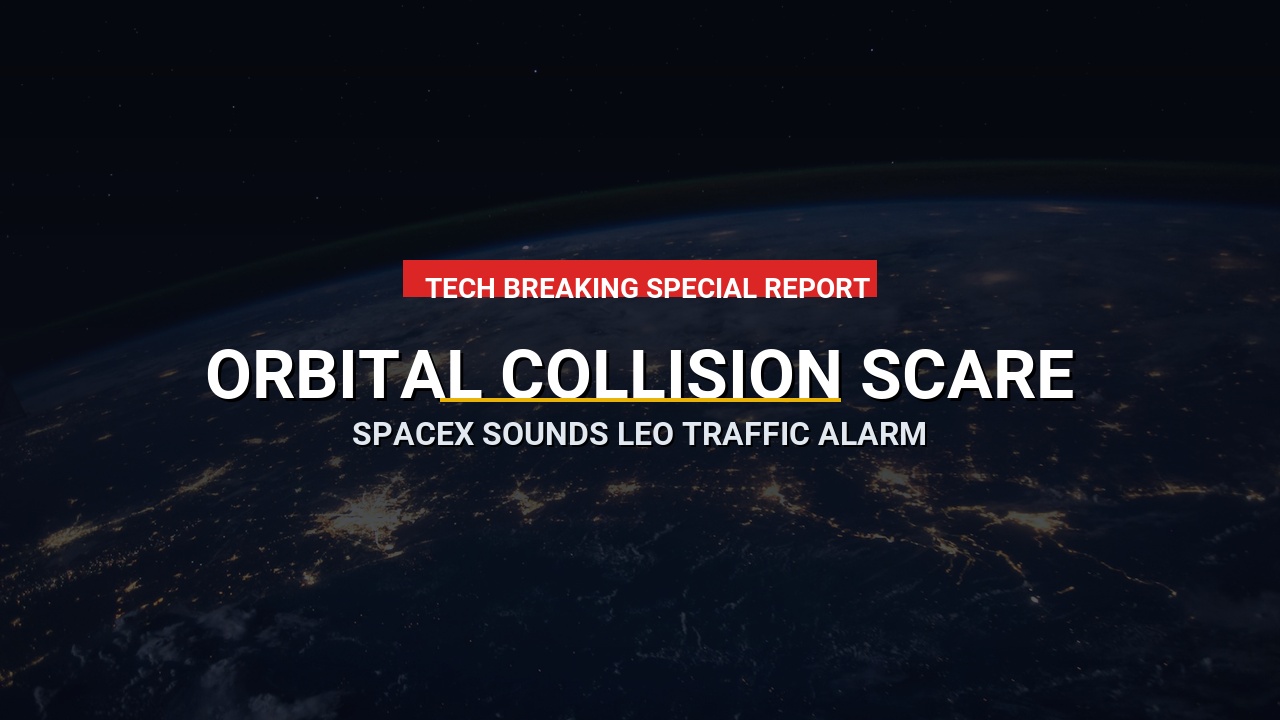
Speaking before space agency heads and defense aerospace leaders at the International Astronautical Congress, SpaceX Senior Vice President Michael Nicolls dropped a statistical bombshell that has sent shockwaves through the global space industry: in 2026 alone, the Starlink constellation has faced potential near-miss collisions with 650 unique maneuvering spacecraft—and roughly half of those operators never shared their flight plans.
Over a single six-month operational window, automated collision avoidance systems on SpaceX’s orbital network flagged an astonishing 164,000 potential conjunction events. While Starlink’s autonomous electric propulsion thrusters fire thousands of times each month to duck out of harm’s way, the revelation that commercial competitors and foreign government satellites routinely execute orbital maneuvers in complete secrecy has exposed a perilous reality: low Earth orbit (LEO) is operating on the brink of an uncoordinated catastrophe.
| Orbital Risk Metric | 2024 Baseline | Current 2026 Operational Reality | Projected 2030 Impact |
|---|---|---|---|
| Active Satellites in LEO | ~9,000 | ~14,500+ (Starlink: >7,200) | 40,000+ (Starlink, Kuiper, Qianfan) |
| Starlink Conjunction Warnings (6-mo) | ~50,000 | 164,000 alerts | Exponential trajectory overlap |
| Maneuvering Foreign Spacecraft Encountered | ~280 | 650 unique satellites | 2,500+ independently steered craft |
| Proactive Ephemeris Data Sharing | Voluntary (<40%) | ~50% compliance | Systemic failure without treaty mandates |
| Minimum Recorded Near-Miss Distance | ~200 meters | 57m (Oct 2025) / 134m (Aug 2026) | Statistical probability of hypervelocity impact |
The Knife-Edge Maneuver: 134 Meters from a Catastrophic Debris Cascade
The terrifying vulnerability of uncoordinated orbits was brought into sharp relief this past August. According to newly declassified telemetry, an unannounced maneuver by an international operator suddenly threw a spacecraft directly into the projected orbital pathway of an active Starlink unit.
With insufficient propellant burn time to escape the collision ellipse entirely, Starlink controllers were forced to command an emergency attitude reconfiguration: rotating the satellite’s sprawling solar panels into an ultra-narrow “knife-edge” profile to shave down its cross-sectional area. The two craft whipped past each other at a closing velocity exceeding 17,500 miles per hour, separated by a razor-thin margin of just 134 meters.
That close call followed an even more harrowing October 2025 incident, where an uncoordinated adjustment by a foreign constellation brought two objects within a breathtaking 57 meters. At hypervelocity speeds, a strike between two 300-kilogram satellites would not merely disable both machines; it would instantly vaporize structural composites and generate a hyper-dense shrapnel cloud of over 250,000 lethal fragments, spraying across neighboring orbital shells.
The Blind Conjunction Crisis: Why Half of Maneuvering Operators Fly Silent
The crux of the crisis lies not in the volume of satellites, but in the glaring absence of transparent flight telemetry. In aviation, every commercial and civilian airliner is legally mandated to broadcast its real-time transponder coordinates and file strict flight paths. In orbit, satellite operators navigate by historical tracking models that can be outdated by hours or days.
SpaceX has responded by launching a public Space Safety platform, open-sourcing hourly predictive ephemeris data—the mathematical calculation of an object’s exact past, present, and future trajectory—for its entire operational constellation. Yet rival operators, sovereign aerospace agencies, and national defense constellations frequently withhold their maneuver ephemerides, citing intellectual property, operational security, or proprietary flight dynamics.
When a satellite maneuvers without publishing its updated ephemeris, automated avoidance algorithms on other spacecraft are effectively flying blind. In hundreds of documented instances, Starlink thrusters initiated evasive maneuvers based on predicted paths, only for the neighboring craft to unexpectedly fire its own thrusters—canceling the safety margin and accidentally steering directly back into the hazard vector.
(Responsive / Native Ad)
The Kessler Clock: How Inactive Soviet Hulks and Megaconstellations Strangle LEO
The escalating traffic jam comes at a moment when orbital debris density is already reaching critical mass. Over recent months, the sudden in-orbit breakups of legacy space junk—such as the Soviet-era Meteor 2-7 weather satellite and the decommissioned U.S. satellite USA 32—have injected thousands of untracked fragments into prime commercial altitudes between 500 and 600 kilometers.
As SpaceX blueprints its roadmap toward 100,000 Starlink broadband craft and contemplates up to 1 million distributed orbital compute nodes for its proposed “Starmind” AI architecture, the margin for error shrinks to absolute zero. If commercial constellations from Amazon (Project Kuiper) and Chinese state-backed networks (Qianfan and Guowang) launch thousands of additional satellites without unified, mandatory data exchange, the mathematical probability of a trigger event for the Kessler syndrome—a chain-reaction cascade of self-propagating debris that renders LEO unusable for generations—transitions from a theoretical warning to an inevitable reality.
Sovereignty vs. Space Safety: The Looming Regulatory Standoff Beyond Earth
The ultimate bottleneck is geopolitical. The 1967 Outer Space Treaty provides no legal mechanism to compel private aerospace conglomerates or rival superpower military constellations to share real-time algorithmic ephemerides.
While the Federal Communications Commission (FCC) and European space authorities have begun tightening domestic de-orbit timelines to five years, national regulators remain powerless to police international operators traversing identical orbital planes.
SpaceX’s public confrontation with non-cooperating operators signals that the era of voluntary space etiquette has officially expired. Unless the International Telecommunication Union (ITU) or a new international space traffic management authority mandates open, real-time ephemeris sharing as a non-negotiable prerequisite for launch licenses, the world’s most vital digital infrastructure will continue gambling its future on knife-edge misses in the dark.