 Hot
Hot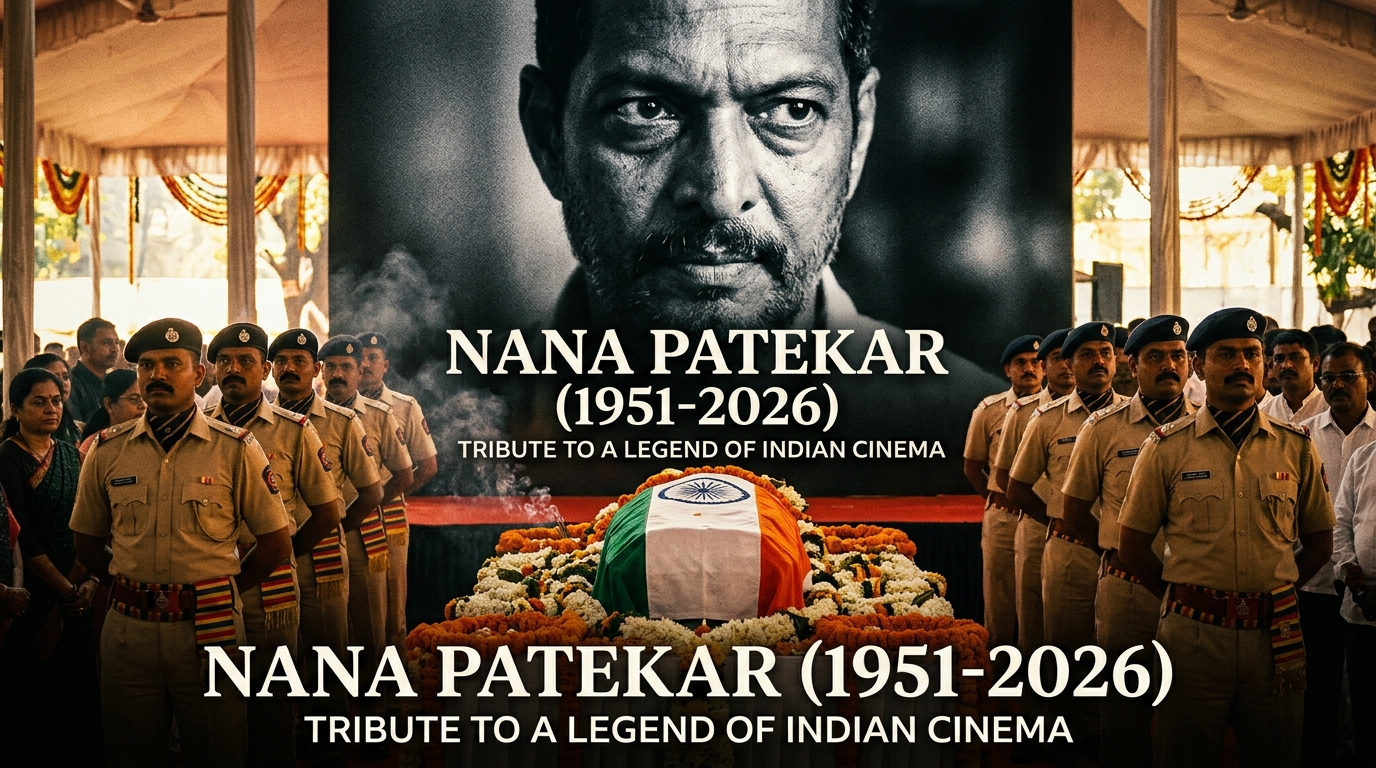
In a devastating rupture across the Indian cultural landscape, legendary actor, filmmaker, and social crusader Vishwanath ‘Nana’ Patekar passed away on the morning of October 8, 2026, at the age of 75.
Patekar suffered a massive cardiac arrest at his residence in Dona Paula, Goa, and was rushed to Manipal Hospital, where medical teams attempted resuscitation for over 45 minutes before pronouncing him deceased at 5:20 a.m. By nightfall, his mortal remains were brought to his farmhouse in Donje village, near Pune, where he was cremated with full state honours—draped in the Indian tricolor and saluted with a 21-gun state salute attended by Maharashtra Chief Minister Eknath Shinde, political dignitaries, cinematic peers including Jackie Shroff and Naseeruddin Shah, and thousands of grieving admirers.
| Landmark Milestones of Nana Patekar | Cultural and National Resonance |
|---|---|
| Cinematic Breakthrough | Gaman (1978), Ankush (1986), Salaam Bombay! (1988) |
| National Film Awards | Best Supporting Actor (Parinda, 1989), Best Actor (Krantiveer, 1994), Best Supporting Actor (Agni Sakshi, 1996) |
| Directorial Tour-de-Force | Prahaar: The Final Attack (1991), trained with the Maratha Light Infantry |
| Kargil War Frontline Service | Honorary Captain, Territorial Army; deployed to Drass and Batalik during Operation Vijay (1999) |
| The Agrarian Lifeline | Co-founded Naam Foundation (2015) with Makarand Anaspure, disbursing ₹50+ crore directly to suicide-hit farmer families |
| Magnum Opus of Late Career | Natasamrat (2016), portraying Ganpat Belwalkar in a historic Marathi theatre adaptation |
The Anti-Establishment Conscience: Why Bollywood Will Never Produce Another Voice Like His
Patekar did not merely enter Indian cinema; he detonated within it. Emerging from the experimental crucible of Mumbai’s Marathi theatre (Purush, Hamidabaadchi Karve) and street plays, Patekar arrived on screen during an era dominated by polished romantic escapism. With his sharp, staccato cadence, penetrating glare, and raw, nervous kineticism, he gave voice to the seething rage of India’s neglected working class.
His portrayal of the psychotic underworld kingpin Anna Seth in Vidhu Vinod Chopra’s Parinda (1989) redefined the grammar of the Hindi film antagonist, earning him his first National Film Award. Five years later, his blistering monologue in Mehul Kumar’s Krantiveer (1994)—challenging communal violence by mixing the blood of a Hindu and a Muslim—became an indelible cultural manifesto that remains unrivaled in rhetorical power.
Unlike modern superstars insulated by public relations managers and contractual brand diplomacy, Patekar weaponized his celebrity to interrogate the state, the police, and societal decay with unvarnished candor.
The Uniform and the Trenches: The Actor Who Answered the Call of Kargil
Patekar’s patriotism was neither cinematic posture nor corporate posturing. In the early 1990s, while preparing to direct his critically acclaimed military drama Prahaar: The Final Attack, he refused to merely observe military life. Instead, he underwent rigorous commando training alongside the Maratha Light Infantry, eventually being commissioned as an honorary Captain in the Territorial Army.
When war erupted in the icy heights of Kargil in the summer of 1999, Patekar did not stay in Mumbai recording patriotic video appeals. He mobilized to the frontlines of the Drass, Batalik, and Kargil sectors, donning combat fatigues, living in high-altitude bunkers with jawans, and delivering psychological morale support under active artillery shelling.
“Nana did not visit the front as an actor waving at troops,” recalled retired infantry officers. “He crawled in the dirt, took weapons training seriously, and looked every soldier in the eye as an equal brother-in-arms. He understood service before self in a way few in show business ever could.”
Mid-Article Ad Space
(Responsive / Native Ad)
Naam Foundation and the Agrarian Shield: Bridging the Divide Between Mumbai and Vidarbha
Perhaps Patekar’s most enduring legacy will not be etched on celluloid, but carved into the dry soil of rural Maharashtra. In 2015, appalled by the catastrophic wave of farmer suicides across the drought-parched belts of Marathwada and Vidarbha, Patekar refused to issue passive social media platitudes.
Partnering with fellow actor Makarand Anaspure, he established the Naam Foundation. Patekar personally toured hundreds of remote villages, handing cheques of financial aid directly to the weeping widows of distressed farmers. Over the ensuing decade, Naam transformed from an emergency relief drive into a vast civil-engineering movement: desilting over 300 rivers and canals, constructing farm lakes, building affordable housing for nomadic tribes, and providing solar power and skill training to thousands of families.
In doing so, Patekar established an unprecedented precedent: proving that cultural icons hold a moral obligation to return their social capital to the soil that feeds them, bypassing sluggish bureaucratic mechanisms to bring immediate salvation to the most vulnerable.
The Irreplaceable Void in an Era of Sanitized Stardom
The sudden demise of Nana Patekar leaves an aching void that extends far beyond the Marathi and Hindi film industries. In a contemporary media landscape dominated by algorithmic image curation, calculated corporate silence, and safe artistic choices, Patekar represented the last of the ferocious truth-tellers.
Whether commanding the screen as encounter specialist Sadhu Agashe in Shimit Amin’s Ab Tak Chhappan, embodying Shakespearean tragedy in Mahesh Manjrekar’s Natasamrat, or confronting state apathy from a dusty drought relief camp, Nana Patekar remained completely, defiantly authentic. As the smoke from his funeral pyre rose into the Pune night sky, India did not merely bid farewell to an actor—it laid to rest a national conscience that answered every crisis with courage, conviction, and an uncompromising roar.