 Hot
Hot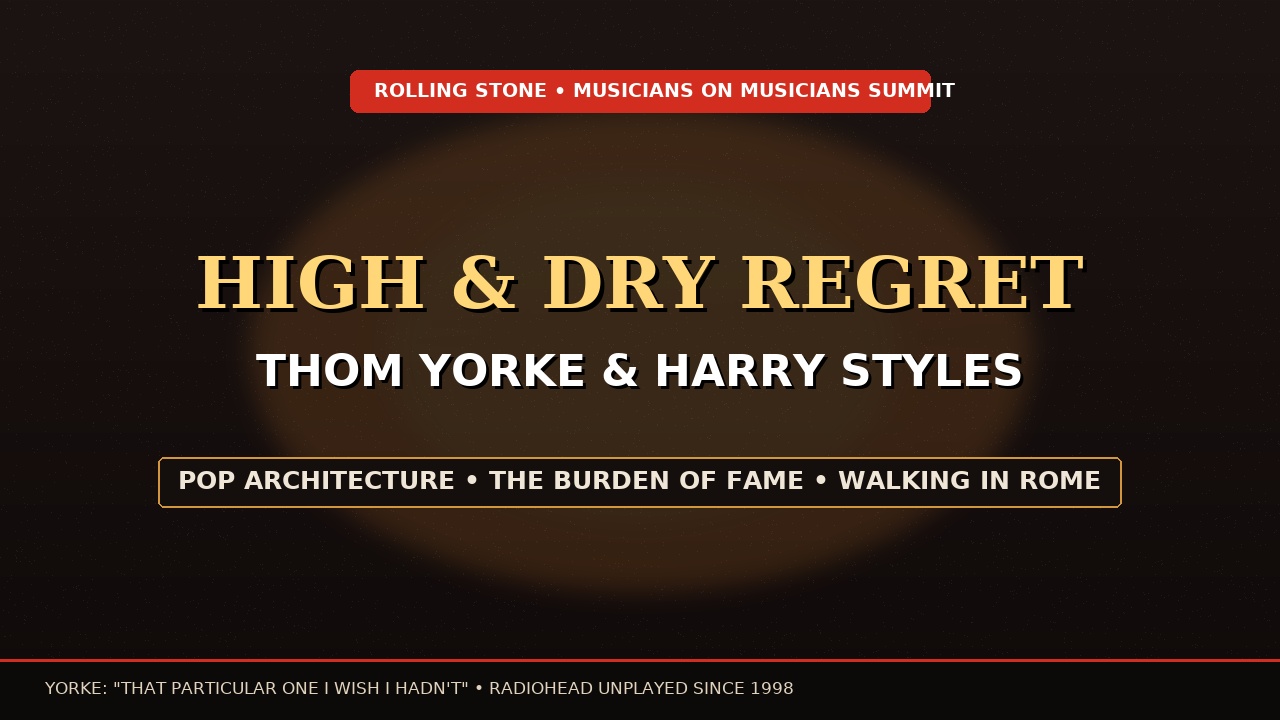
When Rolling Stone paired Thom Yorke and Harry Styles for the cover of its annual “Musicians on Musicians” series in October 2026, music commentators braced for an awkward collision between art-rock’s high priest of alienation and pop culture’s most effortless stadium icon. Instead, the sit-down produced one of the most candid, culturally revealing dialogues of the modern streaming era—anchored by an unvarnished confession that sent shockwaves across music fandom.
During their wide-ranging discussion in London, Styles attempted to pay homage to Radiohead’s legacy by citing “High and Dry”—the shimmering, acoustic-driven single from 1995’s The Bends—as a textbook example of timeless songwriting craft.
Rather than accepting the compliment, Yorke visibly winced in acute pain:
“Yeah, a guy with an acoustic guitar. Singing his song. That particular one I wish I hadn’t [winces], but there’s nothing wrong with that.”
For longtime listeners, Yorke’s discomfort was both illuminating and validating: Radiohead has famously refused to perform “High and Dry” on stage since 1998, viewing it as an artifact of conventional Britpop commercialism that almost derailed the boundary-shattering trajectory leading to OK Computer and Kid A.
| Summit Details | Critical Context |
|---|---|
| Publication & Series | Rolling Stone (October 2026, “Musicians on Musicians”) |
| Featured Artists | Thom Yorke (Radiohead, The Smile) & Harry Styles |
| Initial Chance Meeting | Rome (Summer 2024, spontaneous street recognition) |
| Disowned Anthem | “High and Dry” (The Bends, 1995; unplayed live since 1998) |
| Core Discussion Themes | Pop architecture vs. sonic abstraction, creative isolation, walking |
| Philosophical Focus | Escaping audience expectations and the physical toll of global fame |
The Cringe Heard Across the Music Industry: Disowning a 1995 Masterpiece
The moment Yorke winced at “High and Dry,” he cracked open a long-dormant debate regarding the artistic traps embedded in early breakthrough singles. Recorded during the Pablo Honey sessions and dusted off under label pressure for The Bends, the track achieved platinum-selling ubiquity precisely because of its conventional, strummed chord progression and universal melancholia.
To Styles—whose solo catalog masterfully mines classic rock tropes into pristine pop hooks—the track represents melodic perfection: a song where the vocals and chords communicate without electronic distraction. To Yorke, however, the acoustic troubadour archetype is an aesthetic straightjacket.
Yorke explained that throughout his subsequent three decades of work—from Radiohead’s glitch-laden minimalism to The Smile’s polyrhythmic jazz-rock—he has actively sought to de-center his own voice, treating vocal phrases as atmospheric instrumental textures rather than the heroic centerpiece of a conventional rock tune.
(Responsive / Native Ad)
Pop Architecture vs. Sound Collages: The Clash of Two Songwriting Religions
The exchange between Styles and Yorke illuminated the philosophical chasm separating modern mega-pop from avant-garde experimentation:
- Styles’ Faith in the Chorus: Styles spoke passionately about the discipline of songwriting architecture—the challenge of stripping away production layers until a song can stand entirely alone on a single acoustic instrument or piano.
- Yorke’s War on Formula: Yorke countered by describing traditional songwriting structures as an instinctive trap. For Yorke, genuine revelation occurs when conventional melody is dismantled, forcing listeners to find emotional resonance inside dissonance, looped percussion, and sonic tension.
- The Fear of Repetition: Both artists admitted to profound creative anxiety over recycling their past formulas. Styles confessed that following up record-breaking hits creates an insidious pressure to play it safe, while Yorke described dismantling Radiohead’s signature guitar-rock sound as an urgent act of survival.
The Rome Encounter and the Creative Ritual of Invisible Walking
Beyond musical theory, the summit delved into the psychological toll of inescapable global visibility. The two revealed that their friendship originated not at an industry gala, but on a cobblestone side street in Rome during the summer of 2024, when Styles spotted Yorke walking completely unnoticed by the public.
Styles admitted he had spent years feeling “terrified” of ever meeting Yorke, anticipating an aloof, unapproachable auteur. Instead, they discovered a shared daily coping mechanism: anonymous, long-distance walking in dense metropolitan cities.
Both musicians described walking as their primary shield against isolation and creative sterility. For Styles, navigating crowded streets incognito allows him to observe human behavior rather than being the subject of the gaze; for Yorke, rhythmic walking acts as an internal metronome that dislodges musical blocks when studio sessions hit a dead end.
The Tyranny of the Singalong: Why Stadium Anthems Become Creative Prisons
The broader resonance of the Yorke-Styles summit lies in what it reveals about the relationship between artists and their most famous songs. In an era dominated by algorithmic nostalgia and Spotify catalogue consumption, legacy artists are increasingly pressured to tour as human jukeboxes, faithfully re-enacting decades-old radio hits.
Yorke’s unapologetic rejection of “High and Dry” serves as a rare, defiant manifesto for artistic self-determination. By refusing to cater to casual nostalgia, Yorke reminded both Harry Styles and a global audience of aspiring musicians that longevity is not built on preserving fan favorites—it is built on the willingness to outgrow them, even when the rest of the world refuses to let go.