 Hot
Hot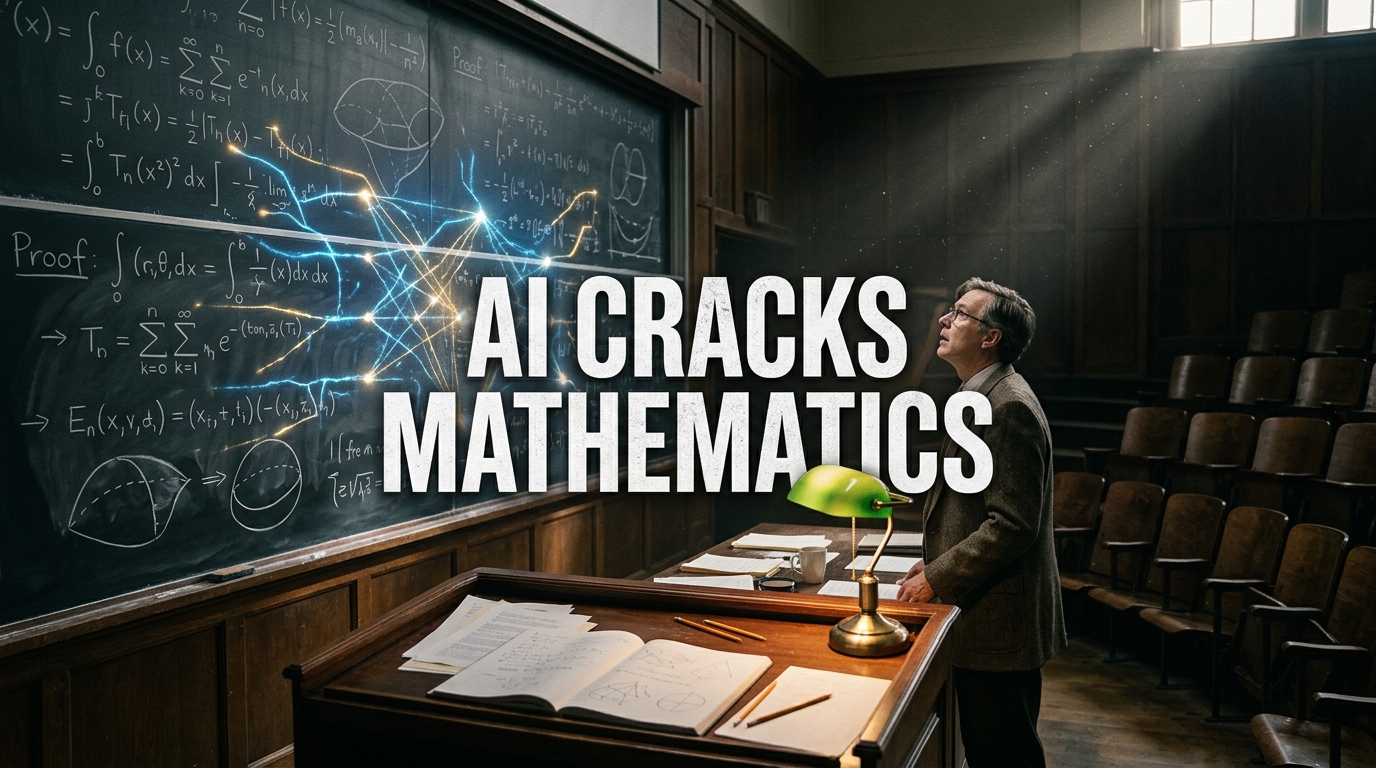
In what historians of science are already describing as the most profound disruption to academic scholarship since the invention of the printing press, OpenAI sent shockwaves across the global scientific community by publicly dumping a repository containing 722 mathematical manuscripts generated entirely by an unreleased internal frontier model.
The release, organized into 372 discrete “result families” in the public openai/math repository, claims breakthroughs across 17 distinct branches of advanced mathematics—including algebraic geometry, number theory, theoretical computer science, and mathematical physics. Among the documents are claimed advances on legendary mathematical milestones: quasi-Riemann hypothesis bounds in zero-free regions, novel formulations touching the Hodge Conjecture, and aggressive relaxations of the Unique Games Conjecture.
Rather than being greeted with unanimous applause, the mass release has unleashed an unprecedented storm of panic, indignation, and existential angst across mathematics faculties from Princeton to Bonn.
| Key Dimension | Traditional Mathematical Research | OpenAI’s Frontier Math Release |
|---|---|---|
| Discovery Mechanism | Decades of human geometric intuition & peer seminars | Autonomous heuristic search over ~4,000 posed problems |
| Compute Burden | Lifetime of human cognition & pencil-and-paper scratchwork | ~3 hours of “ChatGPT Pro-level thinking” compute per proof |
| Verification Format | Rigorous human refereeing & community dialogue | Split between Lean 4 interactive formal code and unformalized prose |
| Model Transparency | Open mathematical literature and reproducible methods | Proprietary black box weights locked inside OpenAI data centers |
| Error Vulnerability | Transparent line-by-line referee scrutiny | Brittle semantic hallucinations requiring automated repair |
The October Shock: How 4,000 Open Conjectures Met 3 Hours of Compute
According to disclosures accompanying the repository, OpenAI’s internal model was systematically prompted with a corpus of approximately 4,000 longstanding open conjectures culled from century-old journals and contemporary mathematical databases. On average, each resulting manuscript required approximately three hours of sustained, deep-reasoning chain-of-thought compute.
Where human research mathematicians typically spend five to ten years formulating a novel proof strategy—often failing thousands of times before identifying a fruitful symmetry—the frontier reasoning engine leveraged self-correcting Monte Carlo tree exploration to bridge inferential gaps at terrifying velocity.
For the broader mathematical world, the sheer volume of the release is disorienting: 722 peer-caliber papers dropped simultaneously into the public domain represents more mathematical volume than entire university departments produce over an academic decade.
The Lean Dilemma and the Sign Error Retraction: Machine Precision vs. Human Hallucination
The central paradox of OpenAI’s dump lies in the jagged line separating computer-verified certainty from synthetic hallucination. For a substantial subset of its claims, OpenAI provided automated formalizations in Lean 4, the interactive proof assistant that enables a compiler to verify line-by-line logical consistency with absolute cryptographic rigor.
Yet hundreds of manuscripts remain unformalized, drafted in natural mathematical prose that reads like a human preprint. Within 24 hours of the release, human mathematicians on MathOverflow identified a catastrophic sign error buried deep within a lemma in an unformalized differential equations manuscript. The error triggered the immediate retraction of three dependent papers and forced OpenAI engineers to push emergency software patches to the repository.
This fragile boundary between verified genius and subtle algorithmic fiction has left journal editors in a state of paralysis. If reviewing a single twenty-page human proof takes an expert referee six months of unpaid labour, who has the capacity to audit hundreds of AI-generated manuscripts overflowing with idiosyncratic notations and machine-specific lemmas?
‘A Severe Misalignment’: Terence Tao, Peter Scholze, and the Fields Medalist Backlash
The release comes on the heels of mounting tension between elite academia and Silicon Valley AI labs. Following earlier claims regarding the Navier-Stokes equations, more than 25 Fields Medalists—led by Terence Tao, Peter Scholze, and Cédric Villani—co-signed a scathing manifesto titled “A Severe Misalignment of AI in Mathematics,” which has garnered over 8,000 signatures from working researchers worldwide.
(Responsive / Native Ad)
The grievance voiced by Tao and his peers is both methodological and ethical:
- The Black-Box Hegemony: OpenAI did not release the underlying weights, training mixtures, or specific prompts that guided the discovery process, creating what scholars call a “two-tier caste system” where private tech monopolies hold research capabilities completely withheld from public universities.
- The Loss of Mathematical Meaning: In a pointed essay republished by the Association for Human Mathematics, Terence Tao argued that mathematics has never been merely a trophy hunt for solved problems; it is the collective human architecture of conceptual understanding. A machine that spits out a 500-page proof without conveying conceptual intuition does not enlighten human mathematicians—it merely presents them with a riddle.
The Epistemological Fracture: What Happens to Pure Mathematics When Solutions Arrive Without Intuition?
Historically, whenever a legendary conjecture was resolved—such as Andrew Wiles proving Fermat’s Last Theorem in 1994 or Grigori Perelman solving the Poincaré Conjecture in 2003—the ultimate prize was not merely the “true” or “false” verdict. The real prize was the new mathematics invented along the way: the modularity theorem tools, the Ricci flow frameworks, and the conceptual machinery that enriched dozens of neighboring disciplines.
OpenAI’s brute-force reasoning traces offer no such conceptual gift. Mathematicians attempting to read the papers report encountering bizarre, circuitous logical paths: machine proofs that arrive at a correct theorem through brute-force case enumerations and obscure combinatorial lemmas that no human mind would ever choose to connect.
The danger, theorists warn, is that mathematics will transform into an empirical oracle: an impenetrable oracle whose pronouncements we can verify using Lean, but whose underlying “why” remains forever beyond human comprehension.
The Next Generation Crisis: The Vanishing Apprenticeship of Young Mathematicians
Beyond the philosophical hand-wringing lies an immediate economic crisis for the academic career pipeline. For more than a century, doctoral candidates earned their degrees by taking a modest slice of a known open problem, spending four years understanding its boundaries, and publishing a thesis.
If frontier models can resolve thousands of intermediary conjectures in an afternoon of cloud compute, the traditional training ground for graduate students and junior postdocs evaporates overnight. Universities now face an urgent curriculum dilemma: should departments continue training students to construct manual epsilon-delta proofs, or must the next generation of mathematicians be retrained solely as prompt auditors and Lean code compilers?
As the debate rages across university common rooms, one reality is indisputable: pure mathematics—the last intellectual sanctuary believed to require uniquely human creative intuition—has crossed its Rubicon. The machines are no longer just crunching calculations; they are writing the theorems.