 Hot
Hot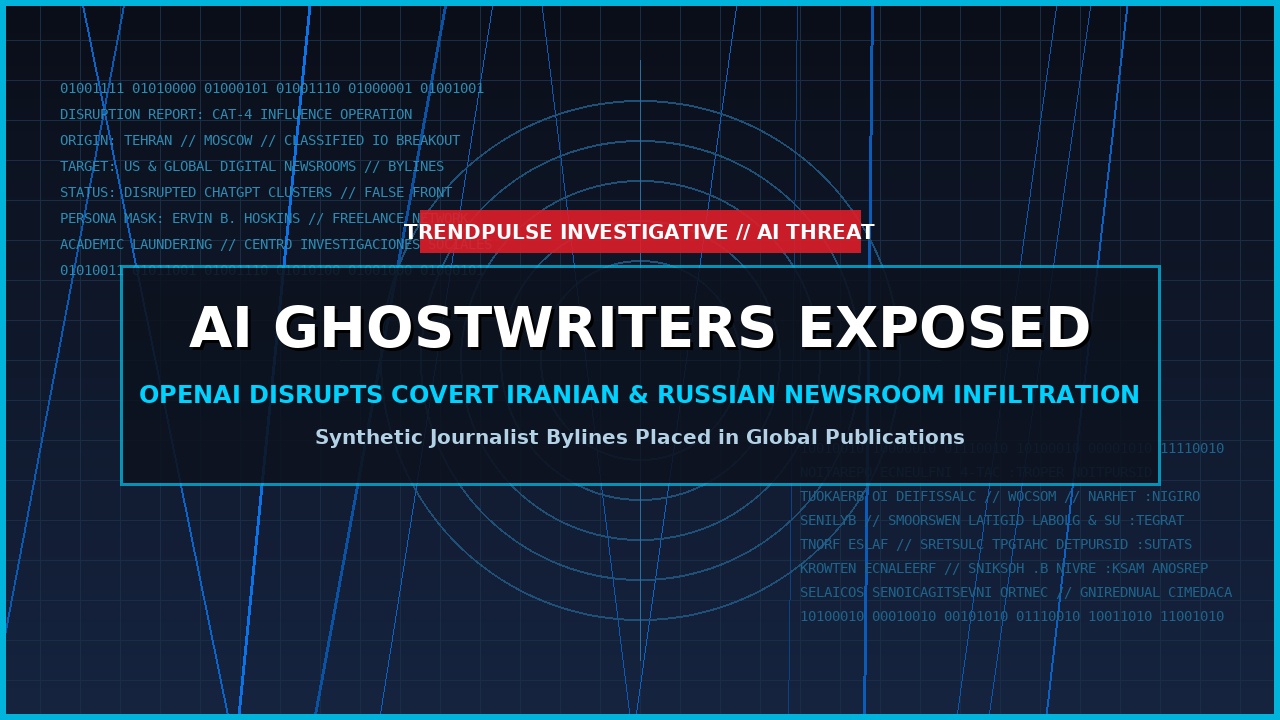
For nearly a decade, counter-disinformation analysts measured state-sponsored propaganda in bot retweets, hijacked hashtags, and broken-English comments flooding social networks. That playbook is officially obsolete. On October 8, 2026, OpenAI published a landmark investigative report titled “Disrupting AI-enabled ‘false front’ operations,” unveiling how state intelligence agencies from Iran and Russia have pioneered a far more insidious tactic: using large language models to construct entire synthetic journalistic personas that directly target and infiltrate legitimate media publications.
Rather than shouting into the void of algorithmic social feeds, Iranian operatives leveraged ChatGPT to generate polished freelance articles under fictitious Western identities. Over a fifteen-month period between July 2025 and October 2026, the network successfully placed nearly 100 published or syndicated pieces across approximately a dozen small-to-medium digital news outlets globally. The operation—rated a severe Category 4 on OpenAI’s Influence Operations (IO) Breakout Scale—represents an alarming escalation in cognitive warfare, transforming generative AI into an automated spear-phishing tool aimed at the gatekeepers of journalism itself.
Beyond the Troll Farm: The Dawn of Editorial Infiltration
The strategic pivot documented by OpenAI marks a fundamental shift in statecraft. While traditional troll farms rely on sheer volume to create synthetic consensus on platforms like X and Instagram, editorial infiltration leverages the built-in credibility, distribution infrastructure, and search engine optimization of established news websites.
Traditional Botnet (2016-2024)         Synthetic Front Operation (2026)
┌───────────────────────────────┐      ┌───────────────────────────────┐
│ • Mass fake social accounts   │      │ • Fully fabricated bylines     │
│ • Repetitive, generic posts   │      │ • Nuanced, multi-page op-eds  │
│ • Easily flagged by platforms │  ──▶ │ • Targets freelance editors   │
│ • Low credibility with readers│      │ • Syndicated via real outlets │
└───────────────────────────────┘      └───────────────────────────────┘
When an article appears under an accredited-looking byline on a syndicated publication, it bypasses platform content moderation algorithms entirely. It gains algorithmic authority on Google News, feeds into financial terminal scrapes, and is cited by human commentators who assume editorial staff vetted the author.
Ervin B. Hoskins and the Mechanics of the Synthetic Persona
At the heart of the Iranian campaign was a cluster of seven fabricated personas designed to simulate authentic Western freelance contributors. Chief among them was “Ervin B. Hoskins,” a purported American geopolitical analyst whose portfolio featured articulate, long-form critiques of U.S. foreign policy, Western military overreach, and Middle Eastern diplomatic maneuvers.
OpenAI’s digital forensics revealed that “Hoskins” was an entirely synthetic construct:
- Linguistic Architecture: ChatGPT accounts tied to Iranian infrastructure were prompted to draft cohesive, academically cited essays calibrated to match the specific pitch guidelines of target independent publications.
- Operational Camouflage: Investigators traced social media accounts amplifying Hoskins’ work directly to an Iranian Android application and Instagram geolocation signals routed through domestic Iranian IP clusters.
- Pacing the Conflict: The velocity of submissions spiked dramatically following military escalations between the United States and Iran earlier in 2026, refocusing article pitches toward demoralizing narratives questioning American naval posture and coalition cohesion.
Why Resource-Strapped Newsrooms Fell for the Machine
The success of these synthetic writers exposes a glaring vulnerability in the contemporary digital media landscape: the acute resource crisis within mid-tier journalism. Over the past decade, cost-cutting measures have decimated editorial desks, leaving editors managing immense content quotas with skeleton staffs.
(Responsive / Native Ad)
| Feature | Human Freelance Contributor | AI “False Front” Submitter |
|---|---|---|
| Submission Speed | Days to weeks per revision | Minutes upon breaking news |
| Remuneration Demands | Competitive freelance rates | Often writes for free / low stipends |
| Tone & Grammar | Requires line editing | Impeccable grammar and formatting |
| Pitch Persistence | Relies on existing relationships | High-frequency custom-tailored pitches |
When a well-written, cleanly structured 1,200-word essay lands in an overburdened editor’s inbox on a breaking geopolitical topic—offered for free or negligible compensation—the structural incentive to accept it without rigorous identity verification proves overwhelming. Operatives weaponized this friction point, turning editorial efficiency against newsroom security.
Dark Clark and the Shift to Institutional Disinformation
Simultaneously, OpenAI unmasked an even more ambitious Russian campaign codenamed “Dark Clark,” which achieved OpenAI’s maximum Category 5 rating. Unlike the freelance persona approach taken by Tehran, Russian operatives constructed a physical shell institution in Latin America called the Centro de Investigaciones Sociales (Social Research Center).
By employing unwitting local researchers and running actual academic-style workshops, Dark Clark laundered synthetic audio scripts and fabricated “leaked” government documents directly into regional discourse. The hybrid combination of real human intermediaries and AI-generated analytical drafts demonstrated that generative intelligence is no longer merely generating disinformation—it is fabricating institutional legitimacy from scratch.
The Verification Crisis: Rebuilding Trust in the Freelance Economy
The revelations in OpenAI’s report are triggering an immediate reckoning across digital newsrooms and publishing syndicates. The era where a professional-sounding email, a LinkedIn profile, and a clean writing sample sufficed for freelance accreditation has collapsed.
In the aftermath of the disclosure, major media coalitions and independent press associations are evaluating mandatory cryptographic identity verification protocols, including biometric video check-ins and verified digital identities before bylines are approved. However, defensive measures risk marginalizing genuine whistleblowers, dissidents, and freelance journalists operating under pseudonyms in authoritarian regimes. As generative models continue to blur the line between human commentary and state-engineered deception, the ultimate defense remains an unglamorous, high-friction editorial vigilance that technology alone cannot automate.