 Hot
Hot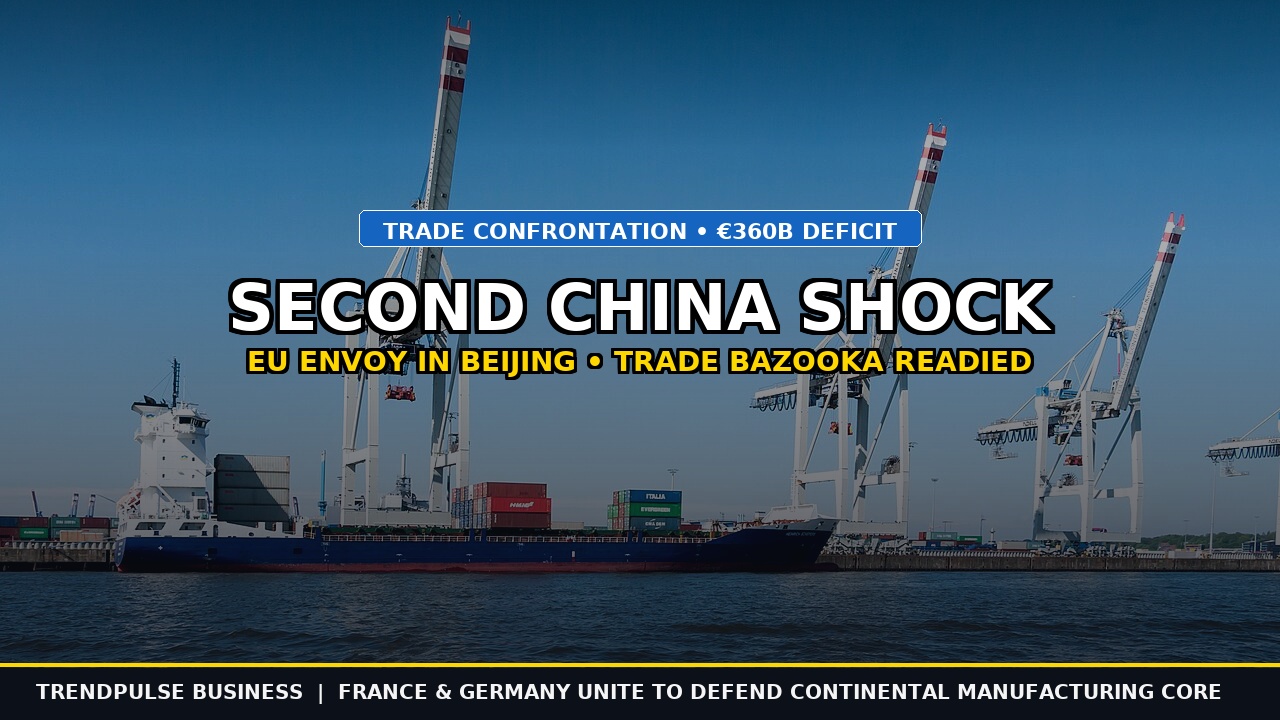
In a dramatic escalation of global trade tensions, the European Union has launched an eleventh-hour diplomatic gambit, dispatching EU Trade Commissioner Maroš Šefčovič to Beijing for high-stakes emergency negotiations. The mission comes amid surging alarm across European capitals that a “China Shock 2.0” is systematically dismantling the continent’s core industrial manufacturing base, from automotive assembly lines in Bavaria to green-tech hubs in Lyon.
The numbers driving Brussels’ urgency are staggering. Driven by massive state subsidies and weak domestic consumer demand in China, Chinese manufacturers have redirected tens of billions of dollars in surplus production toward European ports. The EU’s bilateral trade deficit with Beijing widened to an unprecedented €360 billion in 2025—a gap European Commission President Ursula von der Leyen publicly condemned as an “unsustainable structural distortion.”
As container docks in Rotterdam, Antwerp, and Hamburg overflow with discounted Chinese electric vehicles, lithium-ion battery packs, and high-precision CNC machinery, Paris and Berlin have forged an unprecedented united front. French and German economic ministries are finalizing a joint proposal for a radical defensive trade instrument—dubbed the “trade bazooka”—capable of unilaterally blocking foreign products from systemic, market-distorting regimes.
| Strategic Metric | European Union Exposure | Chinese Industrial Drivers | Policy Collision Point |
|---|---|---|---|
| Bilateral Trade Deficit | Swelled to record €360 Billion annually | Weak domestic consumption forcing export reliance | Deemed “wholly unsustainable” by European Commission |
| Vulnerable Core Sectors | Automotive (EVs), industrial robotics, chemicals | Overcapacity supported by provincial state subsidies | Threat to German Mittelstand and French engineering |
| Defensive Instrument | Proposed “Trade Bazooka” market-blocking kill switch | Appeals to WTO framework alleging western protectionism | Threat of reciprocal tariffs on European luxury & agriculture |
| Diplomatic Delegation | EU Trade Commissioner Maroš Šefčovič in Beijing | Ministry of Commerce (MOFCOM) counter-negotiators | Demands for voluntary export restraints vs. retaliation threats |
| European Internal Consensus | Paris-Berlin alliance hardening defensive posture | Strategic lobbying targeting export-reliant member states | Risk of diplomatic fracture across 27 EU member nations |
The €360 Billion Chasm: How Subsidized Overcapacity Swamped the European Single Market
Unlike the initial “China Shock” of the early 2000s, which primarily displaced low-margin consumer goods, textiles, and basic electronics, this second wave strikes directly at Europe’s high-tech engineering crown jewels. Beijing’s state-directed capital allocation has created massive manufacturing overhangs in advanced industrial sectors. Chinese EV producers, backed by subsidized battery supply chains and cheap industrial power, can profitably land electric sedans in European showrooms at prices 25% to 35% below domestic equivalents.
For Germany’s vaunted Mittelstand—the specialized, family-owned machinery and component manufacturers that long formed the backbone of European prosperity—the pressure has turned existential. German industrial output has contracted across three consecutive quarters as orders for machine tools, chemical precursors, and robotic actuators migrate to heavily subsidized Chinese alternatives. What began as a transition dispute over automotive tariffs has spiraled into a comprehensive battle for European technological sovereignty.
The Franco-German Axis: Forging the ‘Trade Bazooka’ Kill Switch
The most consequential development of the current crisis is the sudden geopolitical alignment between Paris and Berlin. Historically, Germany resisted aggressive trade remedies against China, terrified of jeopardizing the lucrative Chinese sales pipelines of automakers like Volkswagen, BMW, and Mercedes-Benz. However, as Chinese domestic brands like BYD and Xiaomi captured domestic market share within China itself, German corporate leaders realized that acquiescence no longer guaranteed access.
(Responsive / Native Ad)
Together with France, which has long championed aggressive European economic protectionism, Berlin is now backing the creation of a rapid-acting defensive mechanism. Unlike traditional anti-dumping investigations, which grind through bureaucratic reviews for 12 to 18 months while domestic factories shutter, the proposed “trade bazooka” functions as an economic emergency kill switch. Under the draft framework, if foreign state subsidies create demonstrable domestic market harm, the European Commission could impose sweeping volume quotas or provisional tariffs within forty-five days.
Beijing’s Retaliation Playbook and the Fracture Lines of European Unity
In Beijing, Chinese officials have reacted with fierce indignation. The Ministry of Commerce warned that European defensive measures violate World Trade Organization principles and amount to “blatant protectionism masquerading as fair competition.” Chinese state media has already signaled that any punitive European moves will be met with targeted retaliation designed to inflict acute political pain—specifically targeting French cognac, Spanish pork exports, and German precision luxury machinery.
Moreover, Beijing is actively attempting to exploit fissures within the 27-member bloc. Southern and Central European nations that have received billions in Chinese battery plant investments, notably Hungary and Slovakia, remain deeply skeptical of blanket trade restrictions that could jeopardize planned gigafactories. As Commissioner Šefčovič sits across the negotiating table in Beijing, the stakes transcend tariffs and quotas: Europe is deciding whether it can maintain its open, rules-based trading identity without sacrificing the very industrial base that pays for it.