 Hot
Hot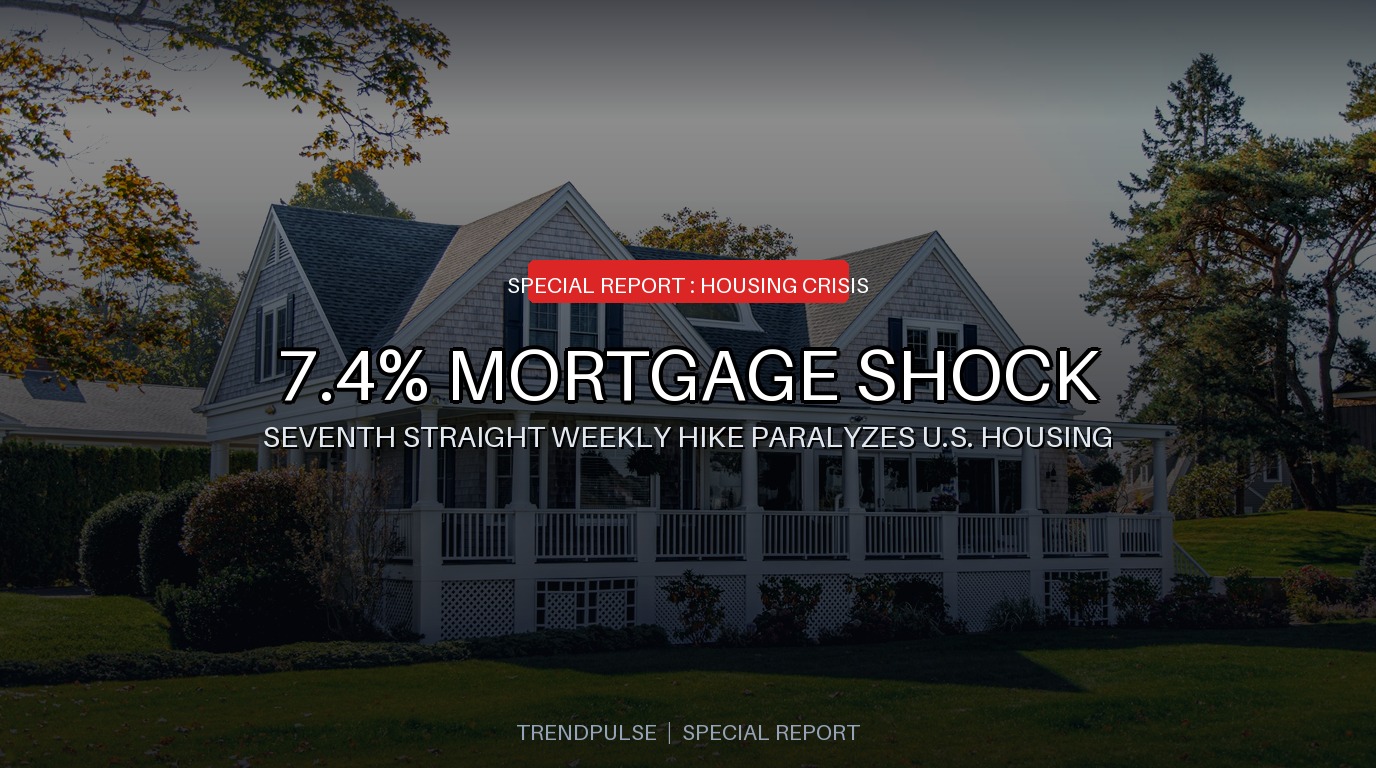
The American dream of homeownership slid further out of reach on October 8, 2026, as the benchmark 30-year fixed-rate mortgage surged to 7.40%, marking its highest borrowing benchmark since November 2023. According to the latest Primary Mortgage Market Survey released by Freddie Mac, the spike represents the seventh consecutive week of relentless rate increases, climbing from 7.28% the previous week and sitting more than a full percentage point above the 6.30% recorded at the same time last year.
Meanwhile, the 15-year fixed mortgage—a standard barometer for homeowners seeking to refinance into shorter amortization windows—climbed from 6.60% to 6.73%, essentially shutting down what little remained of the mortgage refinancing sector. The aggressive climb comes as 10-year U.S. Treasury yields hover near multi-month highs, driven by stubborn core inflation data, volatile bond auctions, and massive federal borrowing requirements.
| Mortgage & Credit Metric | Current Week (Oct 2026) | Prior Week | One Year Ago (Oct 2025) | Net Impact |
|---|---|---|---|---|
| 30-Year Fixed-Rate Mortgage | 7.40% | 7.28% | 6.30% | Highest rate since November 2023; 7-week streak |
| 15-Year Fixed-Rate Mortgage | 6.73% | 6.60% | 5.62% | Refinancing demand drops to historic lows |
| Median Monthly Payment on $400k Loan | ~$2,768 | ~$2,735 | ~$2,476 | +$292/month increase vs. prior year |
| Underlying 10-Year Treasury Yield | 4.62% | 4.51% | 4.02% | Widening mortgage-Treasury spread |
| Existing Home Inventory Turnover | -14.2% YoY | -13.1% YoY | Flat | Lock-in effect solidifies seller gridlock |
The Golden Handcuff Stranglehold: Why Resale Listings Have Dried Up Nationwide
Rather than prompting widespread price cuts, the surge to 7.40% has perversely entrenched an unprecedented supply freeze. More than 82% of existing American mortgage holders are locked into legacy loans below 5%, with nearly 60% enjoying pandemic-era rates under 3.5%.
This extreme disparity has created a paralyzing “lock-in effect.” Even homeowners eager to downsize, relocate for employment, or upgrade to larger properties cannot mathematically justify selling their properties, as trading a $1,600 monthly payment for an identical home at $3,100 represents financial suicide for middle-class balance sheets. Consequently, existing home inventory has cratered across metropolitan corridors from Atlanta to Phoenix, forcing remaining buyers into cutthroat bidding skirmishes over a critically starved pool of new construction homes.
“We are witnessing a market where the traditional transmission mechanism of interest rates is broken,” explains Dr. Marcus Vance, senior real estate economist at the Urban Capital Institute. “Higher rates are supposed to cool demand and reduce home prices. Instead, they have annihilated supply faster than demand, creating an affordability crisis where transaction volumes evaporate but prices refuse to fall.”
First-Time Buyers Forced Into Perpetual Rent: The $2,800 Monthly Hurdle
For prospective first-time buyers without home equity to roll over, the 7.40% threshold marks a catastrophic tipping point. Factoring in property taxes and escalating homeowners insurance premiums—which have surged by double digits across Florida, Texas, and California—the median monthly payment on a typical $400,000 suburban home has crossed $2,800.
Mortgage applications for home purchases have dropped to levels unseen in nearly three decades. Young families and aspiring buyers are increasingly funneled into institutional build-to-rent communities, where corporate landlords backed by Wall Street private equity funds continue to absorb single-family supply. The divide between the asset-owning class locked into 3% debt and aspiring buyers shut out by 7.4% financing has widened into one of the starkest wealth disparities in modern American economic history.
(Responsive / Native Ad)
The Bond Market Disconnect: Why Federal Reserve Cuts Failed to Tame Mortgage Costs
The persistent march toward 7.5% mortgage debt underscores an uncomfortable reality for monetary policymakers: the Federal Reserve’s short-term interest rate adjustments no longer guarantee relief at the long end of the yield curve. Mortgage rates do not track the Fed funds rate directly; they price off the 10-year Treasury note alongside an unusually wide spread demanded by institutional mortgage-backed security (MBS) investors.
With the federal deficit expanding and foreign central banks paring back their purchases of long-dated American debt, bond traders have demanded higher yields to absorb ballooning Treasury issuance. As long as the federal government pumps unprecedented supply into the debt markets, mortgage originators are forced to pass the elevated yield premiums directly onto everyday borrowers.
Collateral Damage: From Auto Credit Stress to the Construction Slowdown
The shockwaves of 7.4% mortgage financing are reverberating beyond real estate brokerage offices into the broader credit ecosystem. Regional banks and credit unions that had banked on a late-2026 lending revival are confronting sluggish loan growth, while automotive finance companies report that consumer debt fatigue is spilling into car loan defaults as consumers exhaust their disposable income on non-discretionary shelter costs.
Simultaneously, homebuilders face mounting pressure. While giants like Lennar and D.R. Horton have used mortgage rate buydowns—offering temporary 5.5% incentive loans subsidized out of their profit margins—to maintain sales velocity, smaller regional builders without deep financing arms are halting land acquisitions. As housing starts slow heading into 2027, the structural shortage of American homes threatens to outlast the interest rate cycle itself, ensuring that whenever rates finally relent, an even worse supply crunch will be waiting on the other side.