 Hot
Hot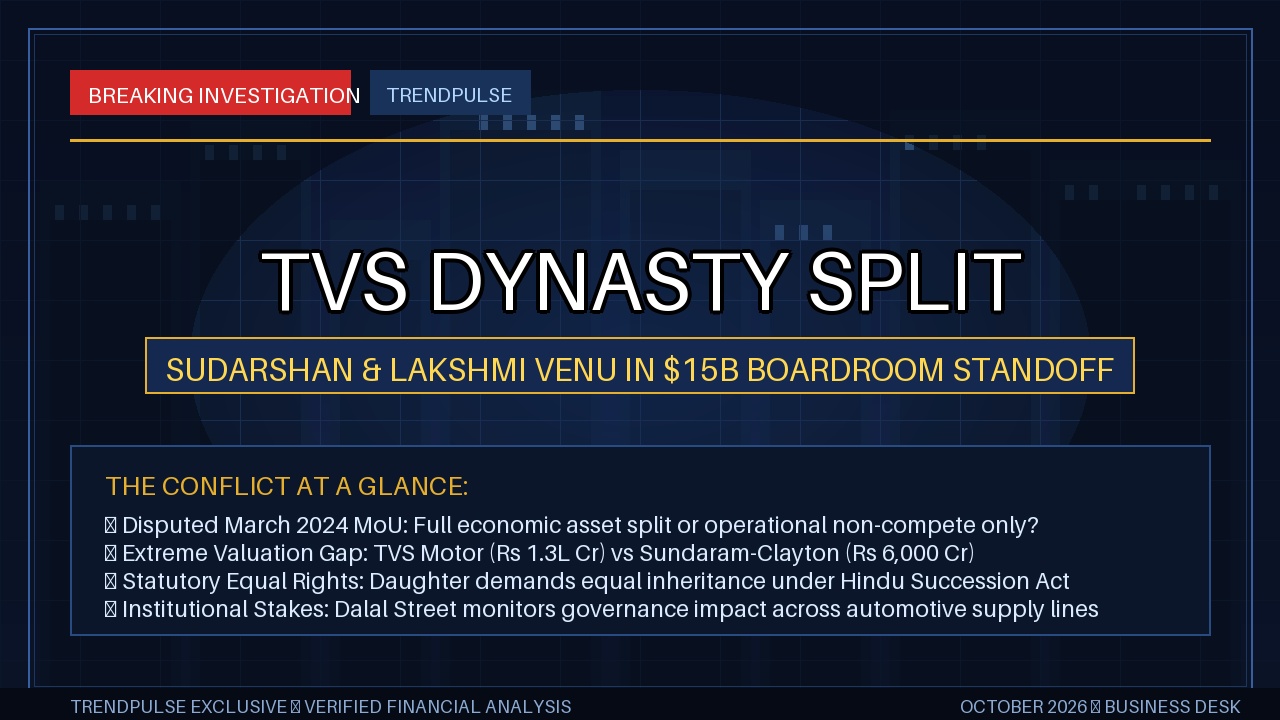
For over a century, the Chennai-headquartered TVS Group was celebrated across Indian industry as the gold standard of corporate discretion and polite, amicable consensus. Even during the group’s historic conglomerate restructuring in 2020 and 2021—when four sprawling branches carved out individual operational empires—not a single harsh word leaked to the press. That legendary veneer of family harmony has abruptly shattered.
An escalating succession and inheritance feud has erupted between Sudarshan Venu, Managing Director of TVS Motor Company, and his elder sister Dr. Lakshmi Venu, Managing Director of auto-components major Sundaram-Clayton. Behind the closed doors of their historic Poes Garden and Adyar residences, top legal counsels and corporate advisory firms are now being briefed for what could become one of India’s most consequential boardroom clashes.
The March 2024 Accord That Failed to Bind the Heirs
At the epicenter of the confrontation lies a confidential Memorandum of Understanding (MoU) executed on March 21, 2024. The pact was originally crafted under the guidance of patriarch Venu Srinivasan, Chairman Emeritus of TVS Motor, to formalize operational boundaries between the siblings before generational succession finalized.
However, eighteen months of simmering disputes have revealed irreconcilable interpretations of what was actually signed:
- Sudarshan Venu’s Camp: Maintains that the March 2024 agreement was a comprehensive, legally binding settlement that permanently settled the ownership and distribution of the family’s economic assets. Under this reading, operational leadership equaled equity ownership.
- Lakshmi Venu’s Camp: Supported by her mother, formidable industrialist Mallika Srinivasan (Chairperson and MD of Tractors and Farm Equipment Limited, TAFE), Lakshmi insists the MoU was merely an interim governance framework intended to set brand usage rules, operational oversight, and non-compete agreements—not a final fiscal division of the family fortune.
The Valuation Chasm: A Two-Wheeler Powerhouse Versus a Legacy Parts Maker
The emotional fuel driving the boardroom split is a glaring disparity in market valuation. Over the past decade, Sudarshan Venu has spearheaded TVS Motor Company’s aggressive global push, orchestrating the acquisition of British motorcycle maker Norton and capturing massive market share in high-margin premium electric two-wheelers through the TVS iQube series.
TVS Motor Company and its core holding entity, TVS Holdings Limited, command a market capitalization exceeding ₹1.3 lakh crore ($15.5 billion). In stark contrast, Sundaram-Clayton—while a critically respected die-casting supplier to global automotive giants—trades at a fraction of that market value.
| Metric / Dimension | TVS Motor Company (Sudarshan Venu) | Sundaram-Clayton (Lakshmi Venu) |
|---|---|---|
| Primary Domain | Two-wheelers, EV mobility, Norton Motorcycles | Aluminium die-casting, automotive components |
| Market Valuation | ~₹1,30,000+ Crore ($15.5B+) | ~₹5,000–₹6,500 Crore (~$700M) |
| Global Reach | 80+ export markets, European R&D | Tier-1 supplier to US and European auto OEMs |
| Contested Scope | Direct consumer brand equity | Industrial supply chain backbone |
Lakshmi Venu’s camp argues that divvying up the family inheritance along current corporate operational lines amounts to an inequitable division that penalizes the sibling entrusted with capital-intensive manufacturing rather than high-multiple consumer products.
Gender Parity and the Hindu Succession Act: The High-Stakes Legal Precedent
Beyond the arithmetic of shares and market capitalization, the rift touches a fundamental pillar of Indian corporate inheritance: gender parity. Under the amended Hindu Succession Act of 2005, daughters hold coparcenary rights equal to sons from birth, establishing an unassailable legal claim to ancestral family wealth.
(Responsive / Native Ad)
Legal advisors aligned with Lakshmi Venu point to landmark Supreme Court precedents affirming that female heirs cannot be sidelined or assigned smaller economic splits in family trusts under the guise of legacy corporate arrangements. If mediation formally collapses and the matter reaches the National Company Law Tribunal (NCLT) or the High Court of Madras, it will test how traditional promoter family compacts interact with modern statutory property rights.
Institutional Investors on High Alert Across Dalal Street
The ramifications of the family dispute extend far beyond the Srinivasan household. TVS Motor and Sundaram-Clayton represent critical bellwethers in India’s automotive supply chain. Institutional mutual funds, foreign portfolio investors (FPIs), and retail shareholders collectively hold significant minority stakes across both listed entities.
Governance analysts note that promoter discord can paralyze major capital expenditure decisions, debt-raising programs, and strategic mergers. Early tremors were felt when governance watchers raised questions regarding promoter influence during Venu Srinivasan’s reassessment of board structures across Sundaram-Clayton earlier this year. Dalal Street is already pricing in a governance discount if an adversarial court battle paralyzes executive bandwidth.
The End of South India’s Gentlemen’s Agreement Tradition
For generations, industrial houses in Southern India—from Murugappa and Amalgamations to TVS—relied on unwritten codes of fraternal compromise and private elders’ arbitration. When disagreements surfaced, patriarchs solved them behind closed doors over South Indian filter coffee.
The battle between Sudarshan Venu and Lakshmi Venu proves that the new generation of global-educated heirs will not quietly accept inherited disparities in wealth. Whether the Srinivasan family achieves an eleventh-hour financial reconciliation or embarks on an acrimonious legal war, the split marks the definitive end of an era for India’s most secretive industrial dynasty.