 Hot
Hot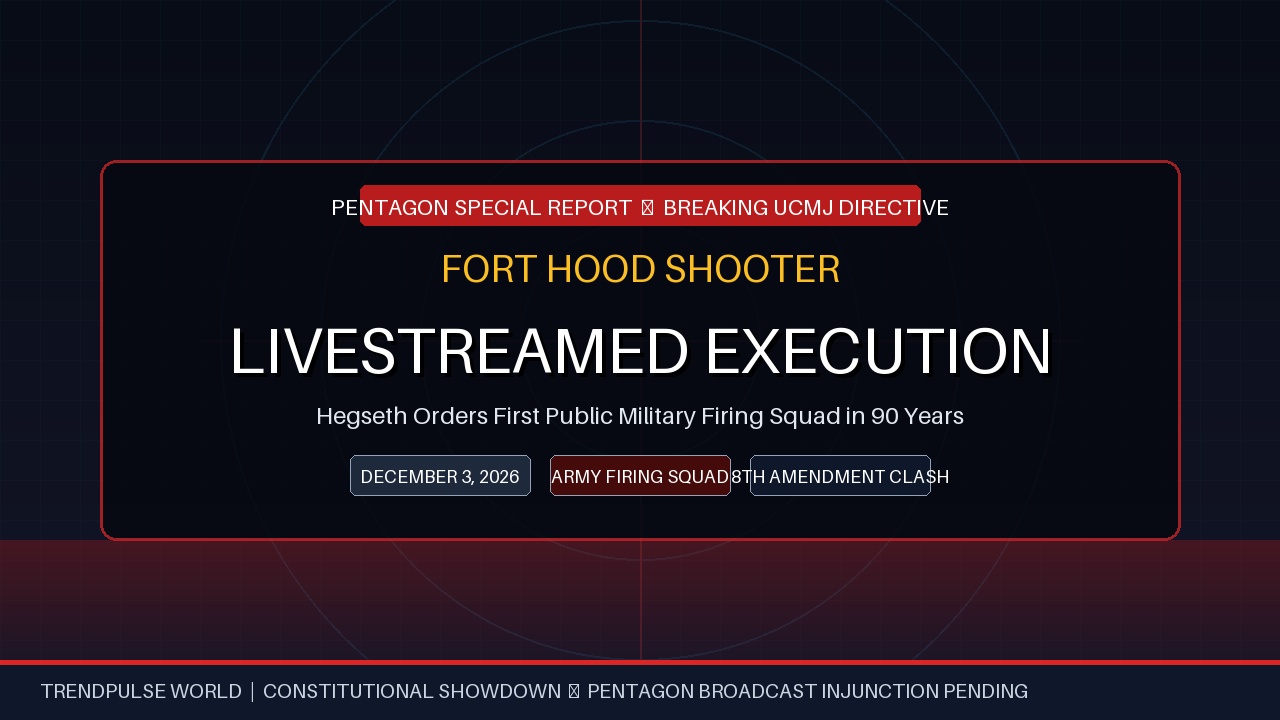
In a dramatic escalation of the Trump administration’s hardline criminal justice doctrine, Defense Secretary Pete Hegseth confirmed that the upcoming execution of convicted Fort Hood shooter Nidal Malik Hasan will not take place behind closed prison curtains. Instead, Hegseth announced that the sentence—scheduled to be carried out by an Army firing squad on December 3, 2026—will be made fully public and livestreamed directly to the American populace.
“We’ll make sure that people are able to watch it, that it’s public, because people need to understand there’s serious consequences for these types of things,” Hegseth stated during an interview on Real America’s Voice. Pentagon spokespersons subsequently affirmed that technical and operational planning for a public broadcast is officially underway, formalizing an executive decision signed off by President Donald Trump following Hasan’s exhausted appeals.
The move instantly reopens one of the most fraught chapters in American military and constitutional history. Hasan, a former Army major and psychiatrist, was sentenced to death by a military court-martial in 2013 for the November 2009 massacre at Fort Hood (now Fort Cavazos), Texas, which killed 13 people and wounded 32 others. If carried out, Hasan’s death would mark the first U.S. military execution since Army Private John A. Bennett was hanged at Fort Leavenworth in 1961—and the first publicly witnessed execution in the United States since 1936.
| Dimension | Standard Military Protocol (UCMJ) | The 2026 Hegseth Mandate | Constitutional & Operational Impact |
|---|---|---|---|
| Execution Method | Lethal injection at USDB Fort Leavenworth | Five-member Army firing squad at Fort Hood | Reverts to historical martial firing squad protocol |
| Witness Access | Strictly limited to victim kin, defense counsel, media pool | Public livestream broadcast via Department of Defense feed | Shatters 90-year ban on public state executions |
| Judicial Precedent | Baze v. Rees & Bucklew v. Precythe standards | Direct executive order bypassing civilian norms | Immediate emergency Eighth Amendment challenge |
| Media Distribution | Closed-circuit record preserved in military archives | Open web stream accessible globally | Content moderation crisis across social media |
From Owensboro to the Digital Public Square: Dismantling the 1936 Precedent
The last time an American jurisdiction conducted a public execution was on August 14, 1936, when Rainey Bethea was hanged before an estimated carnival-like crowd of 20,000 spectators in Owensboro, Kentucky. The nationwide disgust generated by tabloid photography and sensationalized carnival atmosphere prompted state legislatures across the country to permanently move capital punishments inside fortified penitentiaries, far from public gaze.
By replacing the 1930s gallows lawn with high-definition digital streaming, the Pentagon is effectively creating a modern, borderless amphitheater. Proponents inside conservative policy circles argue that state-sanctioned capital punishment loses its intended deterrent power when sequestered in sterile, bureaucratic secrecy. However, legal historians and criminologists point out that past public executions historically degraded civic decorum, incentivized morbid voyeurism, and frequently lionized condemned perpetrators rather than reinforcing public reverence for the rule of law.
The Eighth Amendment Litmus Test: Will Federal Courts Tolerate a 4K State Execution?
Hegseth’s announcement has triggered an immediate mobilization among civil liberties organizations and military appellate defenders. The American Civil Liberties Union (ACLU) and Hasan’s defense attorneys are preparing emergency petitions before the U.S. Court of Appeals for the Armed Forces and the U.S. Supreme Court, arguing that transforming a military execution into a televised media event violates the Eighth Amendment’s prohibition against “cruel and unusual punishments.”
(Responsive / Native Ad)
While the Supreme Court has previously affirmed the constitutionality of firing squads in states like Utah and South Carolina as acceptable alternatives when lethal injection drugs are unavailable, the high court has never ruled on whether the deliberate public broadcast of capital punishment constitutes psychological torment or degrading state spectacle. Defense litigators plan to argue that exposing a condemned soldier to millions of concurrent digital onlookers strips capital punishment of solemnity, transforming due process into unlawful performative retribution.
The Platform Conundrum: How Big Tech and Broadcasters Will React to a Mandated Government Stream
Beyond the military courtroom, Hegseth’s directive drops an explosive regulatory dilemma onto major digital platforms and television networks. If the Pentagon hosts an official video stream on defense.gov or military portal channels:
- Major tech networks including YouTube, Meta, X, and Twitch maintain strict terms of service forbidding graphic depictions of fatal violence and firearms discharges.
- If social media algorithms are flooded with ripped clips, user re-streams, and viral remixes of a fatal firing squad volley, platform moderation infrastructure will face an unprecedented collision between federal government free speech claims and automated safety filters.
- International telecommunications regulators, particularly in the European Union under the Digital Services Act (DSA), may threaten punitive fines against platforms that fail to geoblock graphic execution footage from European feeds.
The Martyrdom Paradox and the Future of Military Capital Punishment
National security analysts are sounding urgent alarms regarding the counterterrorism consequences of Hegseth’s strategy. Throughout his trial and decade-long incarceration, Hasan explicitly characterized his actions through radicalized jihadist ideology, openly seeking death as a self-styled martyr.
Broadcasting his final moments before an Army firing squad in 4K resolution provides violent extremist groups with high-production propaganda material that counterterrorism agencies have spent decades attempting to suppress. Rather than projecting absolute state authority, critics argue the spectacle risks granting Hasan the global public platform he sought from the moment he opened fire. As the December deadline approaches, the clash between executive deterrence and judicial restraint promises to define the moral boundaries of American military justice for the century ahead.