 Hot
Hot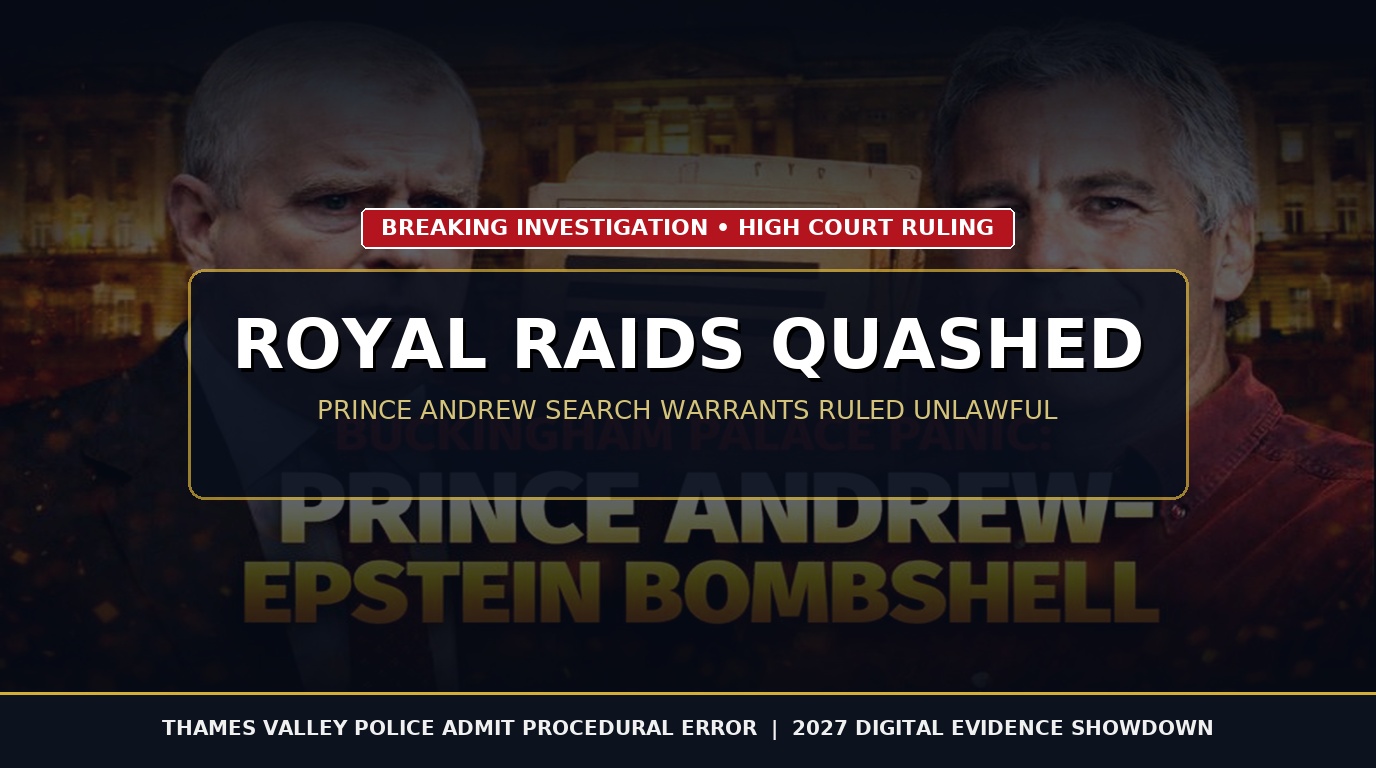
In a devastating judicial blow to Britain’s counter-corruption investigators, the High Court in London on October 8, 2026, officially ruled that the search warrants executed against Andrew Mountbatten-Windsor—formerly Prince Andrew—were unlawful and must be quashed. The extraordinary ruling by Mr. Justice Nicholas Hilliard follows an admission of error by Thames Valley Police, who conceded that detectives applied for and obtained the warrants under the wrong statutory provision when raiding the former royal’s residences earlier this year.
The raids, carried out on February 19, 2026—Mountbatten-Windsor’s 66th birthday—targeted his home on the royal Sandringham estate in Norfolk as well as his former long-time residence at Royal Lodge in Windsor Great Park. Detectives acted in connection with an active criminal investigation into alleged misconduct in public office, probing whether the Duke improperly shared sensitive government documents and market intelligence with the late convicted sex offender Jeffrey Epstein during his ten-year tenure as the UK’s Special Representative for International Trade and Investment.
| Judicial Ruling & Case Breakdown | Details & Legal Implications |
|---|---|
| Presiding High Court Judge | Mr. Justice Nicholas Hilliard (High Court, London) |
| Law Enforcement Agency | Thames Valley Police (Economic Crime & Special Inquiries Unit) |
| Targeted Properties | Wood Farm residence (Sandringham Estate) & Royal Lodge (Windsor) |
| Core Charge Under Probe | Misconduct in public office (2001–2011 trade envoy intelligence disclosures) |
| Grounds for Quashing | Detectives applied under wrong statutory provision of PACE |
| Seized Material Status | Property retention contested; full admissibility hearing slated for 2027 |
| Investigation Status | Active criminal inquiry remains formally open despite warrant collapse |
The Wrong Statute Blunder: How Crown Detectives Tripped Over Special Procedure Rules
The collapse of the search warrants hinges on an elementary yet catastrophic failure in police procedure. When Thames Valley Police sought warrant authorization from an Old Bailey judge on February 18, 2026, they utilized standard entry powers under the Police and Criminal Evidence Act (PACE), failing to navigate the heightened threshold required for special procedure materials and protected institutional correspondence.
Mountbatten-Windsor’s defense counsel swiftly challenged the validity of the searches, asserting that officers had fundamentally overreached their statutory mandate and seized privileged diplomatic archives and legal consultations. Faced with forensic judicial scrutiny in the High Court, police counsel formally conceded that a “significant error” had infected the application process.
Justice Hilliard noted that while the original authorization was invalid, the quashing of the warrants does not extinguish the underlying criminal probe. However, legal scholars argue that acknowledging procedural illegality at the apex of a royal investigation represents one of the most embarrassing missteps in modern British policing history.
The Digital Evidence Limbo: Why Seized Hard Drives Might Never Enter a Courtroom
The critical battleground now pivots from the legality of the physical raids to the fate of the vast digital cache seized by detectives. During the February searches, officers carted away encrypted laptops, personal phones, external backup arrays, and decades of private diaries.
Thames Valley Police have filed an urgent secondary application to retain the seized electronic devices, arguing that the evidence could have been obtained lawfully under alternative statutory powers. Mountbatten-Windsor’s legal team is fighting vigorously for the immediate return and complete destruction of all scanned forensic images, citing statutory fruit-of-the-poisonous-tree jurisprudence under UK law:
(Responsive / Native Ad)
- Privileged State Communications: Royal attorneys claim seized drives contain confidential communications with heads of state and the late Queen Elizabeth II, which are legally immune from warrantless police review.
- The 2027 Retention Showdown: Justice Hilliard scheduled a comprehensive evidentiary hearing for early 2027 to determine whether police may extract and review data from the confiscated hardware.
- Prosecutorial Freeze: Without access to the seized emails and calendar logs, prosecutors cannot corroborate whether trade briefings coincided with Epstein’s international financial transactions.
“If the Crown Prosecution Service cannot lawfully introduce the digital evidence extracted during those raids, the substantive case against Andrew Mountbatten-Windsor effectively stalls on the launching pad,” explained civil liberties barrister Helena Vance. “Detectives handed the defense an exquisite procedural shield through sheer administrative negligence.”
The Public Backlash: Why Britons Fear Another Elite ‘Get-Out-of-Jail’ Loophole
Across the United Kingdom, the High Court’s ruling has ignited immediate outrage among legal reform advocates and civil society groups. To millions of ordinary citizens navigating an austere legal system where minor technicalities rarely halt police proceedings against working-class defendants, the quashing of royal search warrants reinforces perceptions of a deeply entrenched two-tier justice system.
Advocacy groups pointed out the staggering contrast: while counter-terror and economic crime squads routinely execute assertive raids on corporate suspects, police bungled the fundamental statutory paperwork for a former prince accused of leaking state secrets to an international pedophile network. Parliamentarians across the political spectrum are already demanding an independent inquiry into how Thames Valley Police command authorized a flawed warrant on the most scrutinized royal legal case in generations.
Palace In Crisis: King Charles’s Firewall Faces an Agonizing 2027 Hearing
For King Charles III and the working Royal Family, the judicial ruling brings neither relief nor closure. Buckingham Palace had spent months constructing a strict institutional firewall around Andrew—stripping him of royal patronages, military titles, and royal lodge security funding—in an effort to insulate the throne from his mounting criminal liabilities.
Instead of drawing a line under the scandal, the ruling guarantees that the Epstein trade envoy controversy will drag through high-profile courtroom battles throughout 2027. If police are forced to return the hard drives without examining them, public skepticism of Crown neutrality will peak; if the courts allow police to retain tainted evidence, the monarchy faces an excruciating, televised legal trial. For the House of Windsor, the collapse of police warrants offers no redemption—only prolonged institutional bleeding.