 Hot
Hot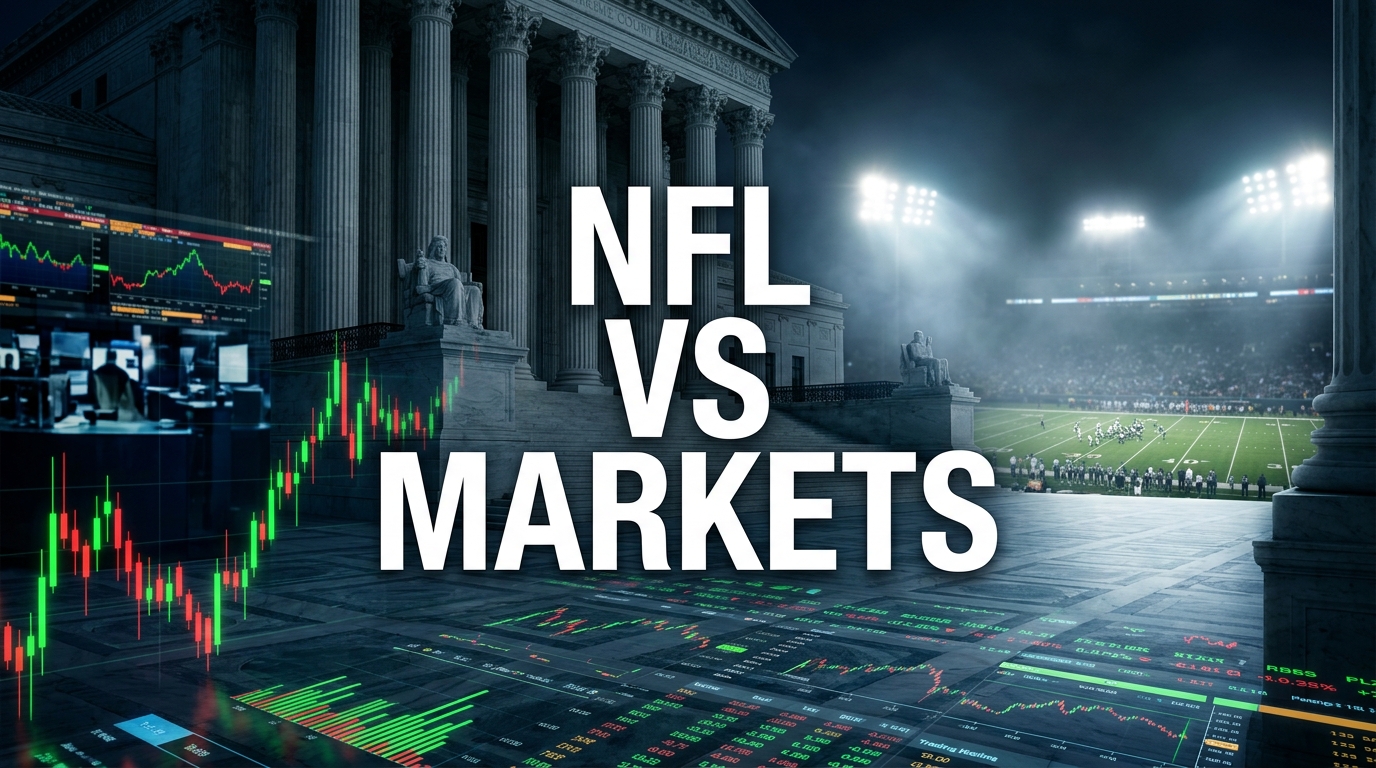
In a dramatic legal intervention that threatens to upend the booming intersection of high-frequency trading and professional athletics, the National Football League (NFL) on Thursday filed a pivotal amicus curiae brief with the U.S. Supreme Court, demanding that the nation’s highest bench intervene to halt the explosive proliferation of unregulated sports-outcome trading.
Backing a petition led by the State of New Jersey, the NFL urged the justices to resolve an escalating nationwide circuit split and rule that sports-focused event contracts offered by platforms such as Kalshi and Polymarket constitute illegal gambling under state statutes, rather than federally preempted financial derivatives. The filing arrived on the heels of staggering autumn data revealing that over $1.8 billion in NFL-linked event contracts were traded across prediction platforms during a single Sunday slate, exposing the multi-billion-dollar friction between Silicon Valley financial engineering and traditional sports betting cartels.
| Strategic Dimension | Regulated Sportsbooks (DraftKings / FanDuel) | Prediction Exchanges (Kalshi / Polymarket) |
|---|---|---|
| Primary Regulator | State Gaming Control Boards (50-state patchwork) | Commodity Futures Trading Commission (CFTC) |
| Legal Classification | Parimutuel / Fixed-Odds Sports Wagers | Federally Registered Event-Contract Swaps |
| Micro-Market Exposure | Traditional Spreads, Moneyline, Player Props | Officiating Penalties, In-Game Injuries, Sideline Feuds |
| Integrity Guardrails | Compulsory Geo-Fencing, Strict Integrity Fees | Federal Commodity Disclosure Rules, Anti-Fraud Probes |
| State Fiscal Take | Direct Gross Gaming Revenue Taxes (up to 51%) | Zero State Gambling Tax (Treated as Capital Gains) |
The $1.8 Billion Loophole: How Financial Swaps Replaced the Corner Bookie
The friction animating the NFL’s sudden Supreme Court offensive stems from a high-stakes statutory sidestep. When the Supreme Court struck down the Professional and Amateur Sports Protection Act (PASPA) in 2018, it returned gambling authority to individual states, sparking a grueling, state-by-state licensing march that took sportsbooks nearly a decade and billions of dollars in lobbying to navigate.
Prediction market exchanges bypassed that regulatory gauntlet entirely by registering as designated contract markets under the Commodity Exchange Act (CEA). By arguing that binary options on whether a quarterback throws two interceptions or whether a field goal hits the upright are legitimate financial “swaps” designed for portfolio hedging rather than games of chance, exchanges opened the floodgates to nationwide, friction-free liquidity without waiting for state-level legislative approvals.
Micro-Contracts and Locker Room Espionage: The League’s Real Integrity Nightmare
Beyond the commercial turf war, the NFL’s legal brief outlines a severe operational terror: the rise of ultra-granular micro-contracts that are practically impossible to police. Unlike broad point spreads or season-win totals, modern prediction platforms permit high-speed trading on granular, hyper-localized moments—including whether an official will throw a pass interference flag on a decisive fourth-quarter drive, or whether a backup offensive tackle will enter the game following an injury timeout.
The league argued that these fractional markets incentivize illicit information-sharing from low-wage personnel: equipment managers, trainers, medical assistants, and chain crews who know an athlete’s physical readiness minutes before it flashes across television broadcasts. With hundreds of millions in anonymous liquidity moving across decentralized ledgers and automated order books, the CFTC’s enforcement arm—designed to monitor agricultural futures and sovereign debt swaps—lacks the real-time forensic infrastructure required to detect court-side point-shaving and locker room tips.
(Responsive / Native Ad)
The Federal Circuit Fracturing: Why the CFTC and State Gaming Boards Are at War
The NFL’s plea lands before the Supreme Court because federal appellate courts have fractured into irreconcilable camps. While the Third Circuit earlier ruled that federal commodity frameworks preempted state attempts to throttle event-contract derivatives, both the Sixth and Ninth Circuits recently delivered blistering counter-rulings, establishing that federal financial deregulation cannot nullify the historic 10th Amendment police powers of states to regulate local vice and gambling.
This circuit split has produced an untenable patchwork:
- Traders in New York and California face fluctuating geo-blocks as state attorneys general issue cease-and-desist orders.
- State treasuries are actively bleeding revenue, watching taxable sports wagering volume migrate to zero-tax event platforms.
- Commercial sportsbook operators find themselves throttled by compliance costs while unregulated competitors operate under federal cover.
Wall Street vs. The Sportsbook Cartel: The Looming Redistribution of Wagering Billions
Should the Supreme Court grant certiorari, the downstream consequences will ripple far beyond the gridiron. An affirmation of state primacy would force prediction platforms to shutter their sports desks or endure the crushing overhead of applying for individual state casino licenses—decimating their current venture-backed valuations.
Conversely, if the high court affirms federal preemption under the CEA, the entire $50 billion commercial sports betting establishment will be forced to undergo radical restructuring. Traditional betting apps would be incentivized to abandon state gaming licenses altogether, reincorporating as financial brokerages to escape state tax rates that exceed 50% in states like New York. As the justices deliberate on whether a fourth-down holding call is a game of chance or a tradeable asset, the boundary between Wall Street speculation and Sunday afternoon football has officially ceased to exist.