 Hot
Hot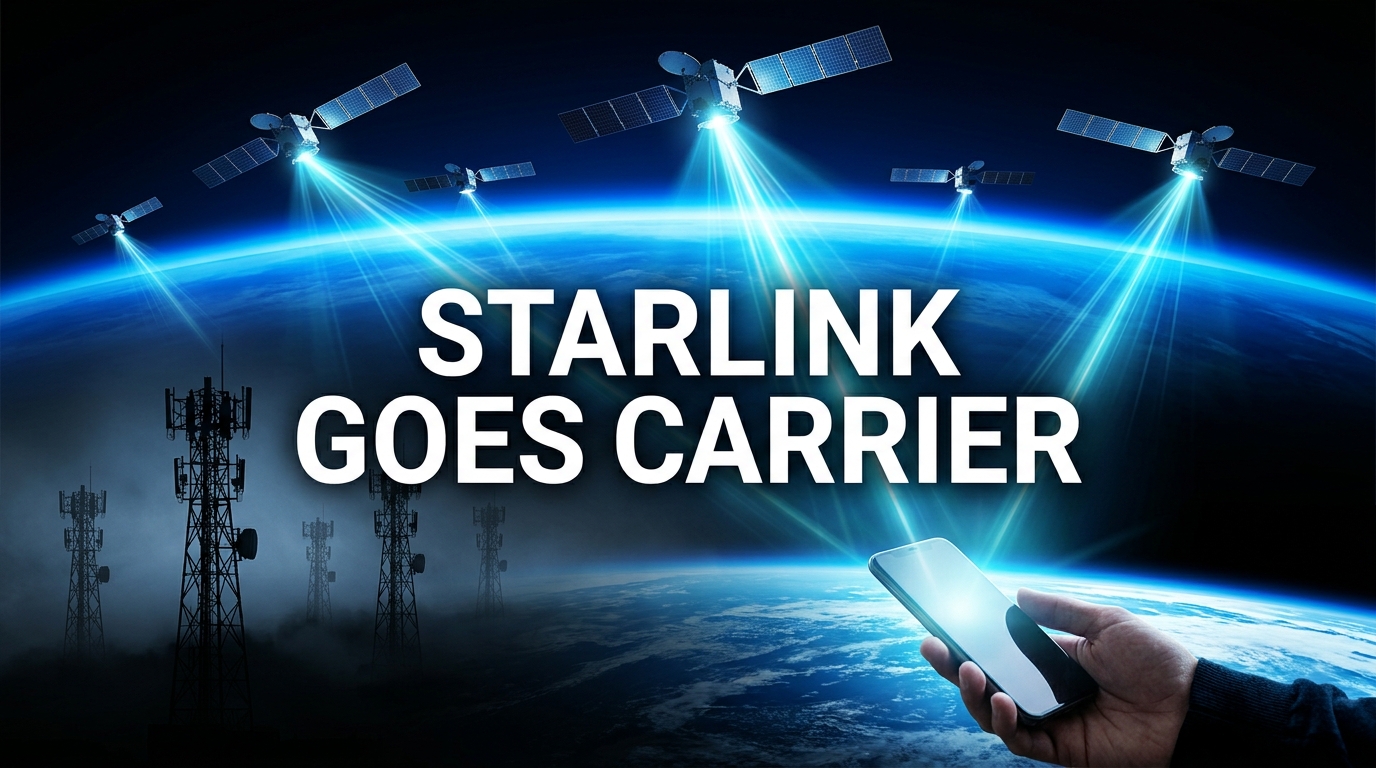
In a structural earthquake that caught Wall Street telecom desks completely off guard, SpaceX on Thursday evening finalized a definitive multi-billion-dollar agreement to acquire the nationwide 800 MHz low-band spectrum portfolio from private equity firm Grain Management.
The transaction—executed within 48 hours of the Federal Communications Commission (FCC) granting SpaceX an unprecedented waiver to deploy a 15,000-satellite direct-to-device (D2D) Gen2 constellation without mandating commercial spectrum leases—marks the official demise of the cellular tower monopoly. By acquiring up to 14 MHz of paired low-band frequencies, Elon Musk has assembled what he publicly characterized as “the last critical piece of the spectrum puzzle,” transforming Starlink Mobile from an auxiliary satellite backup into a fully autonomous, nationwide mobile network operator.
The immediate market fallout was swift and punishing. In after-hours trading, shares of AT&T tumbled 6.8%, Verizon shed 5.9%, and T-Mobile declined 4.7%, collectively erasing tens of billions in enterprise value. Satellite competitor AST SpaceMobile (ASTS) plunged over 11% as investors recalibrated the survival odds of carrier-dependent architectures against an aggressively self-sufficient SpaceX orbital carrier.
| Strategic Metric | Starlink Mobile (SpaceX) | Legacy Terrestrial (AT&T / Verizon) | Carrier-Partner Orbit (AST SpaceMobile) |
|---|---|---|---|
| Core Infrastructure | 15,000 Gen2 LEO Satellites | 142,000+ Terrestrial Macro Cell Towers | Distributed LEO BlueBird Arrays |
| Low-Band Asset | Dedicated Nationwide 800 MHz (Grain) | Licensed 700/850 MHz Terrestrial | Borrowed Carrier Partner Frequencies |
| Indoor Penetration | Direct low-band structural penetration | Macro cellular base station line-of-sight | Dependent on ground-station routing |
| Carrier Dependency | Zero (Sovereign Mobile Operator) | Native legacy operator | 100% dependent on carrier host billing |
| Dead Zone Resilience | 100% continental coverage, zero gaps | Blind spots in rural, maritime & mountain terrain | Intermittent gap-fill during initial deployments |
The Physics of Wall Penetration: Why 800 MHz Was Musk’s Missing Link
For two years, terrestrial telecom executives privately dismissed satellite-to-cellular threats by citing elementary radio frequency physics. While Starlink’s mid-band 2 GHz direct-to-cell tests demonstrated basic emergency text connectivity under clear desert skies, higher-frequency microwave bands cannot effectively penetrate concrete slabs, treated window glass, or heavy tree canopies. For any satellite network seeking to replace consumer phone plans, being unable to ring inside a living room or office cubicle was a commercial non-starter.
The 800 MHz spectrum acquired from Grain Management fundamentally breaks this constraint. Operating in the sub-1 GHz “beachfront” spectrum zone, 800 MHz electromagnetic waves boast long propagation distances and exceptional structural diffraction.
Coupled with the phased-array active steerable antennas on SpaceX’s massive Gen2 Starlink satellites, these frequencies enable standard, unmodified 5G smartphones to maintain continuous voice, RCS data, and broadband sessions indoors without requiring specialized dish receivers or bulky hardware add-ons.
The Carrier Panic: How a 15,000-Satellite Mesh Bypasses the $400 Billion Cell Tower Economy
The panic rippling through legacy boardroom suites stems from the staggering cost asymmetries of orbital telecommunications. Over the past three decades, AT&T, Verizon, and T-Mobile poured more than $400 billion into acquiring municipal spectrum licenses, erecting steel cell towers, negotiating real estate leases, and burying hundreds of thousands of miles of fiber backhaul.
SpaceX’s orbital architecture sidesteps that capital-intensive terrestrial treadmill entirely:
- No Ground Lease Overhead: Starlink requires no municipal zoning permits, rights-of-way disputes, or landowner lease renewals to extend coverage across hundreds of square miles.
- Natural Disaster Immunity: While hurricanes, wildfires, and floods routinely knock out terrestrial base station generators and snap fiber lines, low-Earth orbit constellations operate hundreds of miles above atmospheric turbulence.
- Unified Global Roaming: Traditional carriers rely on complex bilateral international roaming pacts that inflate retail charges; Starlink Mobile functions as a single global software-defined routing fabric.
Recognizing this existential threat, AT&T, Verizon, and T-Mobile had quietly announced a defensive joint venture earlier this month to pool terrestrial spectrum assets for emergency direct-to-device capabilities. But SpaceX’s outright purchase of dedicated 800 MHz frequencies effectively rendered their defensive coalition obsolete before it could clear regulatory filings.
(Responsive / Native Ad)
The AST SpaceMobile Dilemma: When Your Biggest Competitor Stops Playing Partner
The most severe casualty of SpaceX’s sovereign pivot may be AST SpaceMobile. The Midland, Texas-based satellite startup had structured its entire business proposition as a cooperative utility for traditional telecom giants—promising AT&T, Verizon, and Vodafone that it would never compete with them directly, but instead act as their orbital cell tower contractor.
With SpaceX now holding sovereign low-band spectrum and an FCC commercial waiver, Starlink is no longer asking carriers for permission to share subscribers.
AST SpaceMobile must now convince institutional backers that its capital-intensive satellite manufacturing pipeline can outpace SpaceX’s reusable Falcon 9 and Starship launch cadence. If Starlink Mobile offers standalone consumer subscriptions directly through a web portal or eSIM download, the entire carrier-intermediary thesis faces brutal margin compression.
Regulatory Crossfire: The Looming FCC and National Security Showdown
The final battlefield will inevitably play out in Washington. Telecom trade associations and carrier lobbying groups are already preparing legal challenges against the FCC’s waiver, alleging that deploying high-power 800 MHz transmissions from orbit threatens adjacent-band interference with terrestrial emergency dispatch networks and public safety radios.
Furthermore, national security watchdogs and congressional antitrust subcommittees will face thorny questions regarding infrastructure concentration. Granting a single commercial entity control over orbital launch systems, satellite manufacturing, and consumer broadband—now paired with critical mobile spectrum—creates a level of telecommunications sovereignty unseen since the government-mandated breakup of the Bell System in 1982.
Yet as the opening bell approaches, the consumer reality is rapidly shifting: the era of cell tower blind spots is drawing to a close, and the cellular giants are learning that their greatest challenger does not live on the ground.