 Hot
Hot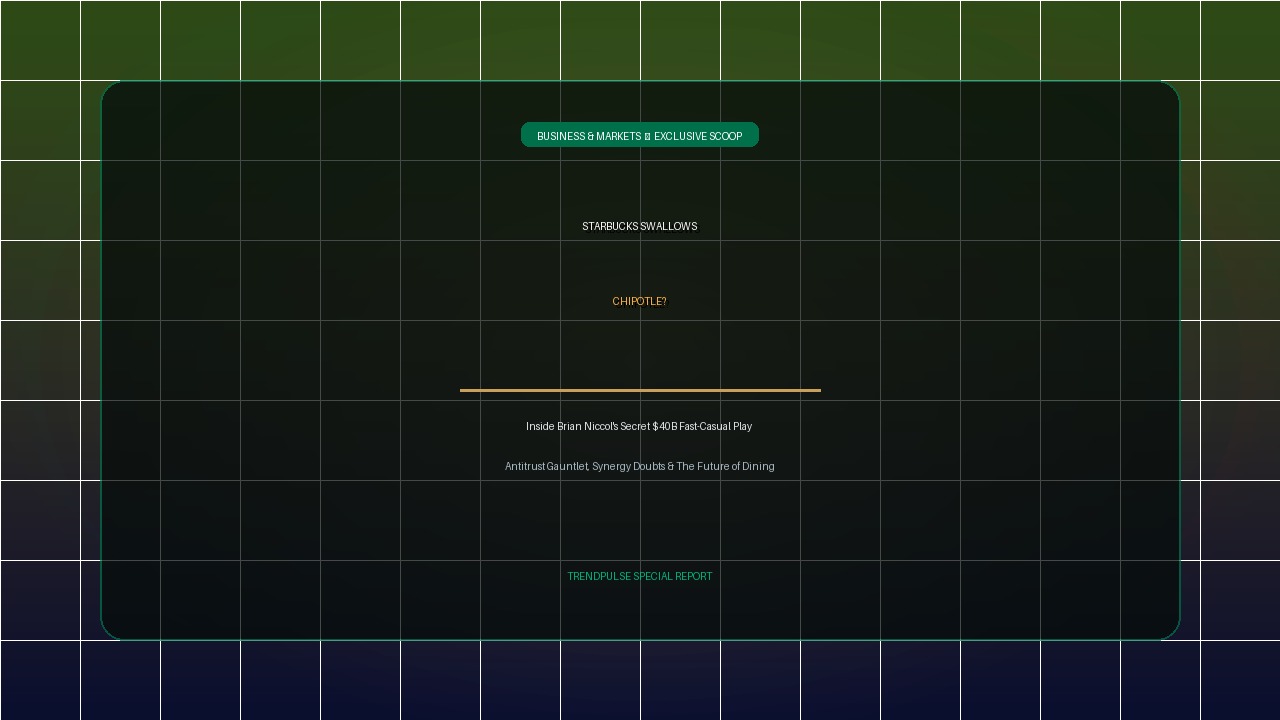
In what would stand as the most audacious corporate roll-up in fast-casual history, Starbucks Corporation has quietly explored a multi-billion-dollar takeover bid for Chipotle Mexican Grill, according to verified reports published by the Financial Times and Reuters. Working alongside investment banking advisers in recent months, executive leadership evaluated structural models to acquire Chipotle—a behemoth with a market capitalization hovering between $39 billion and $41 billion—before the exploratory talks were leaked to international markets on October 8.
The news triggered an immediate surge in Chipotle shares, which jumped nearly 8% in intraday trading, while Starbucks equity wobbled as institutional investors parsed whether the proposal represented an inspired strategic empire or a perilous, balance-sheet-straining distraction.
The Niccol Gambit: Why a Turnaround CEO Looked in the Rearview Mirror
The seismic nature of the talks cannot be understood without the singular figure bridging both corporations: Brian Niccol. In August 2024, Starbucks stunned Wall Street by luring Niccol away from Chipotle with a lavish compensation package to rescue the coffee titan from plummeting store traffic, operational bottlenecks, and mobile-ordering chaos. Niccol had spent six years transforming Chipotle into a high-margin digital powerhouse, overseeing an 800% stock surge and engineering its automated “Chipotlane” drive-thrus.
| Key Metric | Starbucks (NASDAQ: SBUX) | Chipotle Mexican Grill (NYSE: CMG) | Combined Entity (Projected) |
|---|---|---|---|
| Market Valuation | ~$110 Billion | ~$40 Billion | ~$150+ Billion |
| Global Store Footprint | ~38,000 Locations | ~3,500 Locations | 41,500+ Locations |
| Primary Growth Challenge | Afternoon foot traffic & speed | International penetration | Supply chain & capital strain |
| Digital App Users | 34 Million (Active US) | 40 Million (Enrolled) | Unprecedented loyalty overlap |
Rather than closing the door on his former empire, sources close to the deliberations indicate Niccol saw Chipotle’s post-departure valuation slump as a rare acquisition window. With Chipotle shares shedding substantial value following his exit, the calculus was deceptively alluring: marry Starbucks’ morning dominance and unmatched international footprint with Chipotle’s powerhouse lunch-and-dinner throughput.
Smashing the M&A Record Book: The Staggering Arithmetic of a $40 Billion Feast
Should the exploratory talks ever transition into a formal tender offer, the buyout would instantly obliterate every historical precedent in the food-service industry. To date, the largest restaurant acquisition remains Burger King parent Restaurant Brands International’s $11.4 billion purchase of Tim Hortons in 2014. A $40 billion absorption of Chipotle would more than triple that benchmark.
Financing a deal of this scale, however, would force Starbucks to leverage its balance sheet at a delicate juncture. Credit rating agencies have warned that funding a mega-merger through massive debt issuance or substantial equity dilution could jeopardize Starbucks’ dividend commitments and credit tier. Analysts at TD Cowen and Bernstein described the exploratory concept as an “expensive and unforced distraction” when Starbucks is already struggling to execute its fundamental “Back to Starbucks” domestic turnaround.
Burritos Meet Cold Foam: The Operational Mirage of Co-Located Kitchens
Proponents of the tie-up argue that a joint holding structure could solve critical operational voids for both brands:
(Responsive / Native Ad)
- Daypart Complementarity: Starbucks generates over 65% of its sales before 11:00 AM, facing chronic afternoon dead zones. Conversely, Chipotle peaks between 12:00 PM and 2:00 PM and again at dinner. Shared suburban real estate could theoretically extract maximum rent efficiency.
- Global Real Estate Deployment: While Chipotle has struggled for a decade to establish a meaningful footprint outside North America, Starbucks commands thousands of company-owned and licensed stores across Europe, Latin America, and East Asia.
- Automated Order Lines: Both chains rely heavily on complex assembly-line production that breaks down during peak digital demand. Cross-pollinating Chipotle’s second-make lines with Starbucks’ Siren Craft system could offer shared technological efficiencies.
Yet restaurant operational experts caution that cross-brand co-location rarely succeeds. The scent profile of sizzling adobo chicken clashed with freshly ground espresso beans, mismatched refrigeration chains, and vastly differing prep cycles threaten to create operational friction rather than seamless synergy.
The Regulatory Buzzsaw and Wall Street’s Skeptical Reality Check
Even if boards on both sides found common ground, the transaction would face a ferocious antitrust gauntlet. The Federal Trade Commission (FTC) and Department of Justice (DOJ) have aggressively contested retail, grocery, and dining combinations. An entity commanding tens of thousands of prime drive-thru pads and suburban strip mall leases would draw immediate scrutiny over commercial leasing leverage, food distribution procurement power, and labor market monopsony.
Moreover, both Starbucks and Chipotle have experienced contentious organizing campaigns from Workers United and independent labor coalitions. Unifying two massive retail workforces under a single parent holding entity would create a monumental labor front with unified collective bargaining demands across North America.
The High-Wire Dilemma Facing Fast-Casual Dining
Publicly, Starbucks has reaffirmed that its leadership remains “laser-focused on executing the ‘Back to Starbucks’ turnaround,” while Chipotle has declined comment on market rumors. Yet the mere revelation that advisers were actively modeling this megadeal reveals a broader truth about contemporary retail hospitality: organic unit growth in North America is approaching structural saturation.
As inflationary menu fatigue grips consumers, hospitality giants are calculating whether survival requires raw, unprecedented scale. Whether Brian Niccol pulls the trigger on an outright offer or abandons the blueprint as an impossible fantasy, the lines dividing morning caffeine rituals and evening fast-casual dining are blurring faster than ever before.